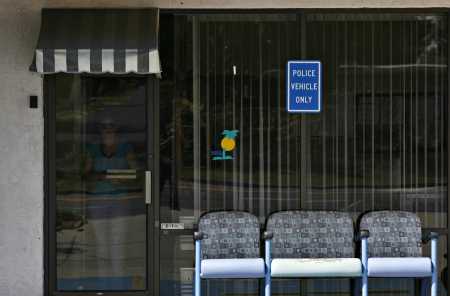
 Pastor
Jeffrey Pohill, operator of Touched By An Angel, Tampa Bay Florida's
largest homeless shelters telling how he operates an unlicensed
telemarketing center.
Pastor
Jeffrey Pohill, operator of Touched By An Angel, Tampa Bay Florida's
largest homeless shelters telling how he operates an unlicensed
telemarketing center.
|
Past Quotes Of The Week |
Read anything interesting or outrageous from our wonderful friends in the telemarketing industry? E-mail it to us! It may be our next "Quote Of The Week!"
March 18, 2012
"We had ex-addicts coming in and we was givin' them their whole check and they was going out and getting high."
Pastor
Jeffrey Pohill, operator of Touched By An Angel, Tampa Bay Florida's
largest homeless shelters telling how he operates an unlicensed
telemarketing center.
In the past five years, hundreds of men, women and children have been helped by Touched By An Angel as it grew into one of Tampa Bay's largest homeless shelters.
But behind a door marked "Pinellas Park Police Substation," the founders of the nonprofit organization have been running an unlicensed telemarketing business that employs some of those residents living at the shelter.
In 2009, police told Touched By An Angel to take down the police substation sign. But the sign remained.
It wasn't until this week that police said they learned that pastors Jeffrey and Vonda Polhill, the shelter's founders, were operating an unlicensed telemarketing outfit in the substation, which had been closed years ago.
"It takes money to remove (the sign) and I'm dealing with homeless people," Jeffrey Polhill said Tuesday before ordering a reporter out of the motel that houses both the call center and his Touched By An Angel Ministries.
The telemarketing business, Fruits of the Spirit, was incorporated in August by the Polhills and two female clients of Touched By An Angel. The Florida Department of Agriculture, which regulates telemarketers, said neither Fruits of the Spirit nor its principals are licensed by the state as required. Failure to register is a third-degree felony.
At first, Polhill said Fruits of the Spirit operates under the license of "someone else" he would not identify. Then he said a state license wasn't needed because callers don't ask for credit card information.
Not true, the department said.
"The use of a credit card is not a factor in whether or not the business must be registered," spokesperson Sterling Ivey said in an email.
In an earlier interview, the Polhills said they are recovered addicts who met while in the Pinellas County Jail. Jeffrey Polhill, 49, also spent time in state prison for offenses that included grand theft and trafficking in stolen property before he started the ministry in 2007.
As Pinellas County's homeless population ballooned, Touched By An Angel was one of the facilities to which social service organizations and Pinellas Park police referred people needing shelter. Many advanced into the organization's transitional and permanent housing programs, paying at least $112.50 a week for rent and program fees.
Touched By An Angel takes a faith-based approach, requiring residents to memorize 85 scriptures and attend five Bible study classes a week. Residents call each other "brother" and "sister," and say "praise the Lord" when answering the phone. The motel, which residents keep scrupulously clean, is dotted with angel statues.
"Physically, it looked good; everybody was required to do something (in order) to stay there," said Sarah Snyder, president and CEO of the Pinellas County Homeless Leadership Network.
But early last year, the network stopped referring people to Touched By An Angel after some former residents complained about the intensely religious atmosphere and lack of privacy. Some also said jobless residents were made to work in a telemarketing operation and that the Polhills took their pay, giving them only a small stipend.
Snyder said she asked to see the organization's financial records "and it wasn't forthcoming. They wouldn't show us the records."
In the earlier interview with the Times, Polhill accused Snyder of "being out to get us" and denied most of the allegations raised by former clients. He acknowledged that residents starting the program turn over their pay to the ministry and receive an allowance until they can show they are financially responsible.
Polhill said Touched By An Angel relies solely on program fees and donations, including those from "sponsors" like Target, Macy's and Bright House. In January, Bright House's Bay News 9 featured a story in which Polhill said Touched By An Angel needed to raise $50,000 in three weeks or it would close.
This week, Polhill would not discuss his for-profit business, which has tapped into a booming area of telemarketing — gas and electricity sales.
Unlike Florida, more than a dozen states have deregulated energy, allowing customers to choose a power company from among competitors.
When a reporter toured the motel grounds last month, Touched By An Angel's marketing director opened a door marked "Pinellas Park Police Substation." Inside was a two-room call center where more than a dozen people were talking to utility customers in New Jersey.
The callers included shelter residents. Snyder, of the homeless network, questioned if telemarketing is the right kind of job.
"It's a very tricky issue — you have to be careful if you're going to be using your clients as a workforce," Snyder said. "There has to be some kind of long-term benefit to the clients in terms of what they learn to do and whether it can translate into an exterior market."
It is not unusual for nonprofit organizations to create for-profit subsidiaries when they want to engage in activities that might endanger their tax-exempt status with the IRS. Depending on the circumstances, a nonprofit can lose its tax-exempt status if its directors receive personal benefit.
Tuesday afternoon, police went to the motel on 62nd Avenue N just west of 34th Street. Capt. Sanfield Forseth said Polhill agreed to scrape off the substation sign. Still remaining is a sign that says "Police Vehicle Only."
"It's not our sign and it's a generic sign that doesn't say Pinellas Park Police," Forseth said. "It's his prerogative if he wants to put a sign up and designate it for police vehicles. We're not going to take issue with that."
Recently, Forseth added, another officer noticed Polhill by the side of the road selling gulf shrimp to raise money.
"He seems to be into a lot of things," Forseth said.
CATS Comment: Charity telemarketers often take most of the donations to pay for the telemarketing, but this is different. They apparently spend most of the money on drugs.
We, here at CATS, wonder how the donors feel about this.
March 11, 2012
"Missourians have told us overwhelmingly that they want their cell phones protected from unwanted calls. Missouri’s No-Call law has been incredibly successful, but it is time to take the next step and expand the law to cell phones.
"The telemarketers who flaunt Missouri’s No-Call law will be prosecuted. We have received hundreds of complaints from consumers receiving these unwanted calls. We will continue to enforce the No-Call laws so that consumers are not bothered at home by illegal calls."
 Attorney General Chris Koster telling the media how he has filed
lawsuits against one California company and four Florida companies
for calling Missourians on the state’s No-Call list. The
Attorney General also again today called on the General Assembly to
include cell phones in the state’s No-Call law.
Attorney General Chris Koster telling the media how he has filed
lawsuits against one California company and four Florida companies
for calling Missourians on the state’s No-Call list. The
Attorney General also again today called on the General Assembly to
include cell phones in the state’s No-Call law.
The Attorney General filed lawsuits against TollFreeZone.com, Inc.; Innovative Wealth Builders, Inc.; BMV Debt Management Corporation; American Credit Counselors; and A+ Financial Center, LLC. TollFreeZone.com is believed to be operating from offices in San Juan Capistrano, California. Innovative Wealth Builders has offices in Clearwater, Florida, and the other three companies are in cities surrounding Palm Beach, Florida.
The cases against BMV Debt Management and American Credit Counselors allege that the companies used a spoofed telephone number to make 20,000 calls during a three-month period. The spoofed number, rather than the actual number called from, is what shows up on consumer’s caller ID system and this misrepresentation conceals from the consumer the identity and origin of the telemarketer.
Consumers should write down the number and the name of the company calling, if known, and then hang up. They can then make notes of any other information provided and report it to the Attorney General at 866-BuzzOff (866-289-9633) or online at ago.mo.gov.
Consumers can assist in locating and prosecuting no call violators in several ways. First, they should try to obtain the telephone number. Unless it is spoofed or blocked, the telephone number will appear on the consumer’s caller ID system. Consumers can also simply ask the telemarketer or dial *69 immediately after the call.
For those receiving a large volume of spoofed calls, consumers can arrange with their telephone company to place a “trap” that tracks information from all incoming phone calls. This technology is available to the telephone company and is not fooled by the practice of spoofing. The trap must already be on the telephone when the telemarketing calls come in. If the number is spoofed, the consumer will be unable to get the information after the calls are made. The phone company charges a fee for this service, but it can provide crucial information if the consumer is willing to make this effort.
Koster today once again urged the General Assembly to pass a law this year add to cell phones to Missouri’s No-Call law. Koster said Missouri residents have asked to register more than 2.3 million cell phones, but currently, the Missouri No-Call law does not allow the Attorney General to register anything but residential landlines
From a press release from the Missouri Attorney General's office, Attorney General sues five telemarketers for violation of Missouri’s No-Call Law, March 8, 2012. Attorney General Koster can be reached, via his office, at: (573) 751-3321.
CATS Comment: Koster is on to something here. It is extreme simple. Enforcement works!
March 4, 2012
"When Missourians register with our No-Call list, they do so with the reasonable expectation that they will not receive these unsolicited, harassing calls. These businesses are aware of our No-Call laws, and they are realizing that this office will enforce those laws."
Missouri Attorney General Chris Koster telling how he has filed suit
against two New York telemarketing companies for making solicitation
calls to Missourians who had previously placed their names on the
state's no-call list. He said the suit came as a result of numerous
complaints filed with the Consumer Protection Division of the
Attorney General’s Office.
Koster filed suit against Predictivedialernow, Inc., and owner Karen Wright, and Salesdialerpro, Inc, d/b/a Sales Technology, LLC, and owner George Kaltner. Both companies are based in Staten Island, New York. Koster said solicitation calls were made to consumers claiming the companies could lower their credit card interest rate or attempting to sell such items as car warranties and health insurance.
Koster said he is asking the court to stop the telemarketers from making calls to Missourians on the no-call list who have no established business relationship with the companies. In addition, he said he is seeking civil penalties for the violations of Missouri law, in addition to the costs of the investigation and prosecution, and all court costs.
From a press release from the Missouri Attorney General's office, Attorney General Koster sues New York telemarketers --asks court to stop calls to No-Call subscribers--, January 5, 2012. Attorney General Koster can be reached, via his office, at: (573) 751-3321.
CATS Comment: Go get 'em Kris. Too bad you aren't in California, we sure could use you here!
February 26, 2012
"A lot of people just can't stand them. The calls could be eating up their (phone) minutes"
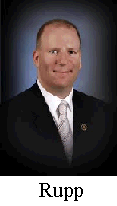 Scott
Rupp, a Missouri State Senator (R-Wentzville) talking about a bill
that he is sponsoring a bill that would require that political
robocalls would have to include a statement saying who paid for the
calls, similar to the statement at the end of political television ads.
Scott
Rupp, a Missouri State Senator (R-Wentzville) talking about a bill
that he is sponsoring a bill that would require that political
robocalls would have to include a statement saying who paid for the
calls, similar to the statement at the end of political television ads.
Rupp, said that type of statement is important because some campaigns can use robocalls to deceive voters rather than promote a candidate. He said his he's received complaints in the past about robocalls made in support of his candidacy that he did not actually endorse. And he said some campaigns will make robocalls in support of their rival at inconvenient times — such as during dinner hour or the middle of the night — in hopes of ginning up voter anger directed at the rival candidate.
Under Rupp's bill, telemarketers that make automated calls without the recipient's permission could face a fine of up $5,000 for each violation.
Robocall measures similar to Rupp's have been filed in the Senate each year since 2007, and proposals to expand the do-not-call list to include cellphones have been introduced in the House in each of the past six years, but none has received a vote by the full House chamber.
The Senate passed separate legislation last week that would also add cellphone numbers to the state's no-call list. The sponsor of that bill, Sen. Will Kraus, R-Lee's Summit, said he intentionally left provisions dealing with robocalls out of his legislation to improve its chance of passing the House.
From CBS News, Mo. Senate backs new limits on 'robocalls', February 23, 2012. Representative Rupp can be reached, via his office, at: (573) 751-1282.
CATS Comment: The TCPA already requires political robo callers to leave a name or phone number where they can be reached. But when CATS founder Robert Arkow complained to the FCC about a robo call from Dan Lundren, then California Attorney General's unidentified robo-call, the FCC took 6 months to answer Arkow, and even though they admitted the calls were illegal, took no action.
But now that the US Supreme court has ruled that telemarketer lawsuits are legal, any person can sue the robocaller or candidate.
Do you think that President Obama will make illegal robo calls? If he calls Bob Arkow and fails to obey the law, Arkow will file a lawsuit.
It will be an interesting election season.
February 19, 2012
"Consumers have complained to us by the thousands about annoying robocalls
"The order we adopt today will require written opt-in, and it will make it easy for consumers to opt out. We're closing loopholes that have allowed robocallers to sneak through"
 Federal
Communications Commission (FCC) Chairman Julius Genachowski
commenting about new robo-call rules during the agency's monthly open meeting.
Federal
Communications Commission (FCC) Chairman Julius Genachowski
commenting about new robo-call rules during the agency's monthly open meeting.
The Federal Communications Commission will enforce stricter rules on so-called telemarketing "robocalls," mandating that these autodialed or prerecorded calls can only be placed to consumers who have already agreed in writing to receive them.
Companies will no longer be able to point to an established business relationship with a consumer to justify the automated pitches.
Robocalls made by charities and political campaigns and providing information like school closings, flight changes and prescription refill reminders will not be affected by the new rules.
The vote cracks down on telemarketers for banks, insurance agents, phone companies and others who used loopholes in the law that established the Federal Trade Commission's Do Not Call Registry to continue to automatically dial consumers.
The FCC said the calls invade consumers' privacy. The agency added that the calls often cut into wireless customers' minutes as more consumers rely solely on wireless services and do not have landlines.
All robocalls will also have to include an automated opt-out option to allow consumers to immediately notify telemarketers that they no longer want to receive these calls.
The FCC also voted to require Voice over Internet Protocol services, or VoIP, to report network outages that affect 911 emergency calls.
The reporting requirements are already in place for traditional carriers, and the vote extends them to the nearly one-third of residential telephone subscriptions provided through VoIP services like those of Vonage Holding Corp.
From Reuters News Service, Regulators crack down on telemarketing pitches, February 15, 2012. Mr. Genachowski can be reached, via the FCC, at: (202) 418-1000.
CATS Comment: Bravo to the FCC on this one. Now for the hard part, enforcing the law. We all can do our part by filing suits under the law and collecting money from the telemarketers. With these new rules, the private right of action clause, and the recent US Supreme Court decision on the Telephone Consumer Protection Act (TCPA) there is no excuse for not filing suit. Stop whining and take action - - Sue the bastards!
February 12, 2012
"Guy called up claiming to be a government official from Washington. He wanted to let me know that because I was retirement age, I was eligible for these medical benefits.
“The bottom line was, he was trying to get my account number off my checking account.”
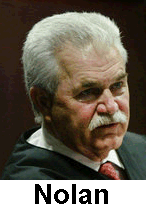 Muskegon
County Judge 60th District Judge Michael J. Nolan learned this week
that no one's immune from telemarketing fraud. – not even a
judge in his chambers.
Muskegon
County Judge 60th District Judge Michael J. Nolan learned this week
that no one's immune from telemarketing fraud. – not even a
judge in his chambers.
Muskegon County 60th District Judge Michael J. Nolan learned that lesson this week.
The 62-year-old judge was in his office at the Michael E. Kobza Hall of Justice when a call came in on his direct line, an unlisted number that bypasses his secretary.
No fool, the judge didn’t provide that. He instead kept the caller on the line, trying to get as much information as possible. The caller didn’t provide much, but Nolan did take the caller’s supposed number off his phone’s caller ID.
Afterward, Nolan brought the call to the attention of Muskegon County Chief Assistant Prosecutor Brett Gardner, who directed the judge to the Michigan Attorney General’s consumer fraud division.
Unfortunately, in this case the scammers covered their tracks.
“They used masking technology to conceal the origin of the call,” said Joy Yearout, spokeswoman for Attorney General Bill Schuette. “It made it untraceable, so we can’t prosecute.”
But prosecutors, both local and state, see the judge’s odd experience as a teachable moment.
Here’s the bottom line: Never, never, never give personal information to an unknown caller.
That’s never, in case you missed it. No matter who they say they are or what they promise, “don’t give private information,” Yearout said.
People should be aware that’s happening here,” said Gardner, the chief assistant prosecutor. “Never give checking account numbers, savings account, Social Security number. If you’re not comfortable, you should contact law enforcement.
“They can rob your account, access your identity.”
Gardner said older people tend to be particular targets, and he believes Nolan's experience implies other people at or near retirement age are being preyed upon in West Michigan.
From the Muskegon Chronicle, Muskegon's Judge Michael Nolan learns: You can't hide from phone scammers, February 12, 2012. His Honor can be reached, via his office, at: (213) 724-6283.
CATS Comment: This is one smart Judge. We would love to bring a TCPA case to his court, as he understands the dynamics of so-called Telephone Sales.
Never give out personal information to a caller that you do not know. It is better to give them phony bank account numbers and other bogus information. They will spend time researching that and get nowhere. Should they call you back, you will get another attempt to identify them. If we all to this it will cut down on both legitimate telemarketing calls and fraudsters.
February 5, 2012
"When Missourians register with our No-Call list, they do so with the reasonable expectation that they will not receive these unsolicited, harassing calls. These businesses are aware of our No-Call laws, and they are realizing that this office will enforce those laws."
Missouri
Attorney General Chris Koster commenting on his lawsuit against two
New York telemarketing companies for making solicitation calls to
Missourians who had previously placed their names on the state's
no-call list. He said the suit came as a result of numerous
complaints filed with the Consumer Protection Division of the
Attorney General’s Office.
Koster filed suit against Predictivedialernow, Inc., and owner Karen Wright, and Salesdialerpro, Inc, d/b/a Sales Technology, LLC, and owner George Kaltner. Both companies are based in Staten Island, New York. Koster said solicitation calls were made to consumers claiming the companies could lower their credit card interest rate or attempting to sell such items as car warranties and health insurance.
Koster said he is asking the court to stop the telemarketers from making calls to Missourians on the no-call list who have no established business relationship with the companies. In addition, he said he is seeking civil penalties for the violations of Missouri law, in addition to the costs of the investigation and prosecution, and all court costs.
Koster reminds Missourians they can sign up for the Do-Not-Call hotline on his website at http://ago.mo.gov/ or by calling 1-866-buzzoff (1-866-289-9633). He encourages consumers who receive harassing solicitation calls to file a complaint at 1-866-662-2551.
From the Missouri Attorney General's website, Attorney General Koster sues New York telemarketers --asks court to stop calls to No-Call subscribers--, January 6, 2012. Attorney General Koster can be reached, via his office, at: (573) 751-3321.
CATS Comment: Go get 'em Chris. Its too bad that the California Attorney General fails to prosecute telemarketers that defraud California residents. But they sure go after victimless crimes but fail to protect Californians against telemarketing fraud. It makes one wonder what they are up to.
January 29, 2012
"First Resource and Stern used a telephone sales boiler room to make inflated claims and defraud investors while simultaneously manipulating the price of the stocks and making profits for themselves. The SEC will continue to aggressively pursue perpetrators of microcap stock fraud schemes that hound potential investors to buy stock."
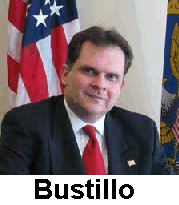 Eric
I. Bustillo, Director of the US Security and Exchange Commission's
Miami Regional Office commenting about an investigation involving
First Resource Group LLC and its principal David H. Stern employed
telemarketers who fraudulently solicited brokers to purchase stock in
TrinityCare Senior Living Inc. and Cytta Corporation. While
recommending the securities in these two microcap companies, Stern
sold First Resource’s shares of TrinityCare and Cytta stock
unbeknownst to investors who were purchasing them – a practice
known as scalping. As Stern was selling the stocks, he also purchased
small amounts in order to create the false appearance of legitimate
trading activity and induce investors to purchase shares in both companies.
Eric
I. Bustillo, Director of the US Security and Exchange Commission's
Miami Regional Office commenting about an investigation involving
First Resource Group LLC and its principal David H. Stern employed
telemarketers who fraudulently solicited brokers to purchase stock in
TrinityCare Senior Living Inc. and Cytta Corporation. While
recommending the securities in these two microcap companies, Stern
sold First Resource’s shares of TrinityCare and Cytta stock
unbeknownst to investors who were purchasing them – a practice
known as scalping. As Stern was selling the stocks, he also purchased
small amounts in order to create the false appearance of legitimate
trading activity and induce investors to purchase shares in both companies.
Since the beginning of fiscal year 2011, the SEC has filed more than 50 enforcement actions for misconduct related to microcap stocks, and issued 63 orders suspending the trading of suspicious microcap issuers. Microcap stocks are issued by the smallest of companies and tend to be low priced and trade in low volumes. Many microcap companies do not file financial reports with the SEC, so investing in microcap stocks entails many risks. The SEC has published a microcap stock guide for investors and an Investor Alert about avoiding microcap fraud perpetrated through social media.
According to the SEC’s complaint filed against Stern and First Resource in U.S. District Court for the Southern District of Florida, they violated federal securities laws by acting as unregistered broker-dealers. Stern hired and trained First Resource’s salespeople and gave them information about TrinityCare to prepare sales scripts and pitch the stock to potential investors. Stern reviewed the draft scripts, made edits, and approved the scripts before the salespeople were allowed to use them.
The SEC alleges that Stern gave the salespeople a list of potential investors to cold call and pitch the stocks. First Resource’s salespeople falsely claimed TrinityCare stock “is going to be $5-7 in 6-12 months” and the company “is going to be a half-a-billion dollar company in five years or roughly a $40 stock.” Stern also disseminated a research report on Cytta to investors and falsely touted: “Sales projections for 2010-2014 should exceed $500 million with a pre-tax net of over $400 million.”
The SEC’s complaint alleges that First Resource Group and Stern violated Section 17(a) of the Securities Act of 1933, and Sections 10(b) and 15(a) of the Securities Exchange Act of 1934 and Rule 10b-5. The SEC is seeking permanent injunctions, disgorgement plus prejudgment interest, and financial penalties as well as a penny stock bar against Stern.
The SEC’s investigation was conducted by Jorge L. Riera under the supervision of Elisha L. Frank in the SEC’s Miami Regional Office in coordination with an examination of First Resource conducted by Anson Kwong, Michael J. Nakis, George Franceschini, and Nicholas A. Monaco of the SEC’s Miami office. Edward D. McCutcheon will lead the SEC’s litigation efforts.
From a press release from the SEC, SEC Charges Boiler Room Operators in Florida-Based Penny Stock Manipulation Scheme, January 26, 2012. Mr. Bustillo can be reached, via his office, at: (305) 982-6300.
CATS Comment: The old adage still rings true: If it sounds too good to be true, it probably is. And if it comes from a telemarketer, you can be bet it is not true.
January 22, 2012
"Congress also provided for civil actions by private parties seeking redress for violations of the TCPA or of the Commission’s implementing regulations." (Emphasis added)
 US
Supreme Court Justice Ruth Bader Ginsburg delivering a unanimous
verdict in the case of Mims V Arrow.
US
Supreme Court Justice Ruth Bader Ginsburg delivering a unanimous
verdict in the case of Mims V Arrow.
The Supreme Court is keeping telemarketers and other businesses on the hook for nuisance phone calls, letting those annoyed by the disruptions sue in federal as well as state courts.
The high court's decision Wednesday involves a lawsuit claiming a debt collector harassed a man with repeated recorded calls.
Marcus Mims of Fort Lauderdale, Fla., said he kept getting the calls from Arrow Financial Services LLC, which was trying to collect a student loan debt for Sallie Mae. He sued for violations of the Telephone Consumer Protection Act, passed by Congress to ban invasive telemarketing practices.
Mims' lawsuit was thrown out by the 11th U.S. Circuit Court of Appeals, which said that Congress did not explicitly give permission for federal lawsuits in the Telephone Consumer Protection Act, although the law does say people can file in state courts. Other federal courts ruled differently and let lawsuits move forward.
The high court said in a unanimous opinion that federal lawsuits are allowed under the law.
From The United States Supreme Court, January 18, 2012, Justice Ginsburg can be reached via the court telephone at: (202) 479-3000.
CATS Comment: The highest court in the land has finally chimed in on the TCPA and said that that lawsuits can be filed for "violations of the TCPA or of the Commission’s implementing regulations." One of those regulations is the regulation that telemarketers are required to provide a copy of their written do not call policy "upon demand."
So when you get another annoying telemarketing call, you should ask the telemarketer to provide a copy of their policy, and when they don't (and 99% won't) provide a copy of their policy, file suit against them.
The US Supreme court says that it is legal and encouraged by Congress. Finally Congress did something right!!
We love you Ms. Ginsburg, you go girl!
January 15, 2012
"The tragedy of this is this very vulnerable young baby is going to get her start in life without her mother.
"How in the world could you contemplate bringing a child into the world when you told me your world was destroyed?"
U.S. District Judge G. Patrick Murphy rejecting Jennifer Kirk’s request for a 12-year term and admonished the 31-year-old New Jersey woman for starting a family even after her scheme had drawn the attention of state and federal authorities.
He sentenced the architect of a timeshare telemarketing scheme that bilked $30 million from 22,000 victims to more than 15 years in prison Monday, waving off the new mother’s sobbing claims of remorse.
Federal prosecutors say Kirk operated Florida-based Universal Marketing Solutions and later Creative Vacation Solutions from October 2007 to December 2009, employing telemarketers who falsely told timeshare owners in unsolicited calls that they had buyers for their properties.
Using what federal prosecutor Bruce Reppert described as slick sales tactics, Kirk’s workers solicited closing costs of up to several thousand dollars from people across North America and Puerto Rico, and promised to refund them when the deals closed, supposedly within two to three months, the U.S. government alleged. But Kirk’s companies sold few if any of the timeshares and pocketed those fees.
Kirk, of Howell, N.J., had no previous criminal record when she pleaded guilty in June to charges of conspiracy to commit mail fraud and wire fraud. She said her “horrible decisions” had brought shame on her family.
Murphy fined Kirk $15,000 but did not order her to pay restitution, saying that was inconceivable given the scope of the scheme. It was not clear if any of the victims attended Monday’s sentencing hearing; none took Murphy up on his offer to speak their mind.
Three of Kirk’s former employees spun off a similar timeshare scam as Real Timeshare Marketing, which federal prosecutors say made $1.3 million using the same tactics that Kirk employed. Those men, prosecuted separately from Kirk, are serving prison sentences handed down last year in East St. Louis ranging from 18 months to 10 years in prison and have been ordered to repay the money, with one of the defendants facing a restitution tab of $1.1 million.
Murphy accepted the defense’s request that Jennifer Kirk, formerly of Florida’s Lake Worth and Wellington, remain free on bond until she’s required to report to a prison, which Kirk’s attorneys say they hope is in Connecticut to allow her to be near her daughter.
From the Washington Post, Sobbing timeshare telemarketing scheme boss sentenced to more than 15 years in prison, January 9, 1012. Judge Murphy can be reached, at his chambers, at (618) 482-9173.
CATS Comment: Good for you judge. But may we suggest an additional punishment?
Ms. Kirk should have a telephone at her dinner table in prison and it should ring with telemarketing calls during her dinner. She should be required to answer the calls during the time allotted for her dinner meal.
Now that would be a punishment fitting the crime!
January 8, 2012
"It's a free medical card scam. Telemarketers are telling people they don't have to pay expensive medical costs.
“It's not in Bandera, and we want to keep it that way.
"We want to know if it happens so that we can try to prevent it from happening again.”
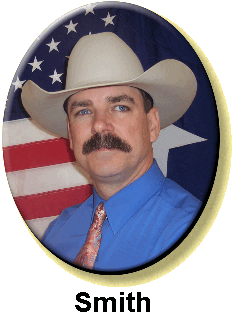 Bandera
County TX Chief Sheriff Deputy Richard Smith telling that callers
advise people that at no cost to them, the company they represent
require only a bank account number. Smith said callers use the line,
“All citizens on Medicare should be using these 'free
cards,'” and older citizens in the area are at particular risk.
Bandera
County TX Chief Sheriff Deputy Richard Smith telling that callers
advise people that at no cost to them, the company they represent
require only a bank account number. Smith said callers use the line,
“All citizens on Medicare should be using these 'free
cards,'” and older citizens in the area are at particular risk.
Bandera County residents comprise less than five percent of these scam complaints. Never give out personal information to anyone. Don't allow scammers to bully or pressure you into giving information.
Urging anyone who may have fallen victim to one of these scams to notify the authorities immediately, Smith said people often don't report because they are ashamed or embarrassed.
From the Bandera Bulletin, Free medical card latest telemarketing scam, January 4, 2012. Mr. Smith can be reached, via his office at: (830) 796-4323.
CATS Comment: We agree with the saying, "Don't Mess with Texas."
Good luck sheriff fighting these criminals. Telemarketers are the scourge of the sales world, taking advantage of people at a weak moment and not telling them the whole story about what they are buying.
Give 'em some Texas justice, Richard!
January 1, 2012
"FSA employees do not and will not call individuals offering to sell items or package deals to producers,"
 Brad
Pfaff, state executive director for the Wisconsin Farm Service
Agency telling how many FSA offices have been contacted by producers
who are getting fraudulent calls from individuals posing as FSA
employees who are offering a package deal for power tools.
Brad
Pfaff, state executive director for the Wisconsin Farm Service
Agency telling how many FSA offices have been contacted by producers
who are getting fraudulent calls from individuals posing as FSA
employees who are offering a package deal for power tools.
Wisconsin consumer protection officials say consumers should hang up on telemarketer requests for personal information like credit card or bank account numbers.
"This is a common telemarketing scam," said Sandy Chalmers, administrator of Trade and Consumer Protection. "To get your credit card number, criminals will tell you they're from the IRS, Medicare or even the Farm Service Agency."
The Department of Agriculture, Trade and Consumer Protection offers the following tips regarding fraudulent phone solicitation:
Resist high pressure sales tactics. Legitimate businesses respect the fact that you're not interested.
Take your time. Ask for written information about the product, service, investment opportunity or charity that's the subject of the call.
Before you respond to a phone solicitation, talk to a friend, family member or financial advisor. Your financial investments may have consequences for people you care about.
Check out testimonials to make sure they're genuine — not statements that have been bought or paid for.
Don't send money — cash, check or money order — by courier, overnight delivery or wire to anyone who insists on immediate payment.
Keep information about your bank accounts and credit cards to yourself — unless you know who you're dealing with.
Before you pay, check out the company with the Bureau of Consumer Protection. Call (800) 422-7128.
For more information or if you believe you have received one of these fraudulent calls, contact the Bureau of Consumer Protection by calling or emailing datcphotline@wisconsin .gov.
From the GreenBayPressGazette.com, Farm service agency cautions customers on fraudulent calls, December 27, 2011. Mr. Pfaff can be reached, via his office, at: (608) 662-4422.
CATS Comment: You tell 'em Brad!
It seems that telemarketers will tell anyone anything in order to obtain information to defraud the people call.
Why do they do it? In a nutshell, telemarketing works. Using social engineering techniques, telemarketers can often get the information that they need to defraud the people.
So let's start out the new year right, OK? Resolve to waste telemarketers' time and give them false information that they cannot use. This will throw a monkey wrench into their operations.
C.A.T.S. wishes all a happy and telemarketing free new year.
December 25, 2011
"The THPA isn’t affiliated with the Texas Department of Public Safety or its Highway Patrol Division.
“State investigators found that few survivors actually receive any financial assistance. Instead, investigators discovered that the defendants unlawfully utilized donors' charitable contributions for their personal use, including meals, in-house pet care, entertainment and unauthorized travel by board members, their friends and families"
 Texas
Attorney General Greg Abbott telling the media that he has secured
an asset freeze and temporary restraining order against the Texas
Highway Patrol Association and two affiliate organizations, the Texas
Highway Patrol Museum and THPA Services, which he accuses of
illegally soliciting donations and claiming falsely that donations
would benefit the families of fallen state police officers.
Texas
Attorney General Greg Abbott telling the media that he has secured
an asset freeze and temporary restraining order against the Texas
Highway Patrol Association and two affiliate organizations, the Texas
Highway Patrol Museum and THPA Services, which he accuses of
illegally soliciting donations and claiming falsely that donations
would benefit the families of fallen state police officers.
The suit names the THPA and several officials including former State Rep, Lane Denton, D-Waco, who founded the THPA in 1990 and now serves as director of Texas Highway Patrol Services.
Denton served in the Texas House from 1971 to 1977.
In September 1995, a jury in Travis County convicted Denton of theft and misapplication of fiduciary property in the diversion of more than $67,000 from the Texas Department of Public Safety Officers Association while serving as executive director in 1988 and 1989.
Denton, who maintained his innocence, was sentenced to 10 years in prison on each of two counts, but his sentence was suspended and he was placed on six years of community supervision.
From KWTX.com, Assets Of Texas Highway Patrol Association Frozen, December 19, 2011. Attorney General Abbott can be reached, via his office at: (512) 463-2100.
CATS Comment: Good for you Mr. Abbott. Go get 'em!
Phoney charities are a rip-off for sure, especially when the use the name of law enforcement to gain funds. All States should pass legislation that prohibits telemarketing of law enforcement charities.
It is simply bad business and has the appearance of taking bribes.
When we, here at CATS, receive a telemarketing call from a police charity, we drop the phone and yell "the cops are on the way, dump the meth down the toilet," and then hang up.
They never seem to call back!
We here at CATS wish all, including telemarketers, a very Merry Christmas and a happy New Year.
December 18, 2011
"The winter months are an especially difficult time for those in need, and thankfully, many enerous New Yorkers are eager to extend a helping hand during the holiday season. That’s why it’s important for donors to know exactly how much of their money will be spent on charitable programs and how much will be used to pay for fundraising costs. Generosity is the hallmark of the holidays, and my office wants to ensure that New Yorkers planning on making a charitable donation this year have the information they need to protect themselves and the people they aim to help. Especially in these tough economic times, the people of this state deserve to know that their hard-earned dollars are going where they are intended to go."
 New
York Attorney General Eric T. Schneiderman telling that he has
released his office's annual fundraising report documenting how
for-profit “telemarketers” pocket the bulk of contributions
New Yorkers give to charities. The Attorney General also issued a
guide for consumers planning on making charitable contributions this
holiday season, with important information to ensure that donations
go where intended.
New
York Attorney General Eric T. Schneiderman telling that he has
released his office's annual fundraising report documenting how
for-profit “telemarketers” pocket the bulk of contributions
New Yorkers give to charities. The Attorney General also issued a
guide for consumers planning on making charitable contributions this
holiday season, with important information to ensure that donations
go where intended.
According to Pennies for Charity, Where Your Money Goes: Telemarketing by Professional Fundraisers, in 2010, an average of just 36.9 cents of every charitable dollar raised by these professional telemarketing companies actually went to charity. Many charities across the state received even less – and in 61 of the 564 telemarketing campaigns, the charities actually lost money.
The report synthesizes information filed with the Attorney General’s Charities Bureau by professional fundraisers who conducted telemarketing campaigns in 2010. The Attorney General’s interactive Web page also allows potential donors to easily search the report by the name of the charity or by region of the state. A link to the search tool can be found on the Attorney General’s Web site at www.charitiesnys.com. Users can see how much money was raised and how much money actually went to each charitable organization.
According to the report, telemarketers raised a total of over $249 million on behalf of 411 charities in 2010. In total, $157 million, or approximately 63 percent, was paid to the telemarketers as profits, fees and other costs of the campaigns, leaving charities with less than 37 percent of the money actually raised for their causes.
Some of the significant findings regarding the 564 fundraising campaigns covered in the Attorney General’s report include:
In 77 percent, or 435 of the 564 campaigns, the charities kept less than 50 percent of the funds raised.
In 263, or 47 percent of the 564 campaigns, the charities retained less than 30 percent of the funds raised.
In 61 of the 564 campaigns reflected in the report, charities actually lost money.
In only 46 of the 564 campaigns did the charity retain at least 65 percent of the money raised, the amount deemed acceptable under the Better Business Bureau’s standards for charitable organizations.
In total, 63 percent, or $157 million, of the funds raised by 81 telemarketers in 2010 was paid to fundraisers for fees and/or used to cover the costs of conducting the campaigns. By comparison, charities retained 37 percent, or $92 million, of the total funds raised in the campaigns.
Since taking office, Attorney General Schneiderman has aggressively pursued charity fraud to protect New Yorkers’ hard-earned dollars. Last week, the Attorney General announced he successfully barred a Connecticut fundraising company and its owner from soliciting charitable contributions in New York State after fraudulently using telephone solicitations for over 30 public safety organizations. The Attorney General also shut down the Long Island-based Coalition Against Breast Cancer (CABC) which solicited $9.1 million from the public over the past five years, but spent virtually no money on the breast cancer programs it said it supported. Additionally, last month, the operator of a bogus Long Island charity, Coalition for Breast Cancer Cures, was sentenced to 2 to 6 years in prison for stealing over $500,000 intended for breast cancer, and he and his wife were also ordered to pay $1.5 million in restitution, as part of a settlement secured by Attorney General Schneiderman.
In light of this report and as the end-of-the year giving season begins, Attorney General Schneiderman also issued tips for consumers as they consider making charitable contributions:
Resist Pressure To Give On The Spot. If you receive a call from a telemarketer, do not feel pressured to give over the phone. You can just say no. If you choose not to hang up, you should ask the caller what programs are conducted by the charity, how much of your donation will be used for charitable programs, and how much is the telemarketer being paid and how much is the charity guaranteed.
Look Up Charities. Review information about the charity before you give. Check the Attorney General’s website – www.charitiesnys.com – for charities’ financial reports or ask the charity directly for this information. Confirm that the charity is eligible to receive tax-deductible donations by searching the IRS website at www.irs.gov/app/pub-78/. Some additional websites with helpful information include:
American Institute of Philanthropy - www.charitywatch.org
Better Business Bureau Wise Giving Alliance - www.bbb.org
Charity Navigator - www.charitynavigator.org
GuideStar - www.guidestar.org
Give to Established Charities. Donate to organizations you are familiar with, or have a verifiable record of success meeting their charitable missions, whether it is establishing a college fund or providing health services. Closely examine charities with names similar – but not identical to – more established organizations.
Ask How Your Donation Will Be Used. Ask specifically how the charity plans to use your donation, including the services and organizations your donation will support. Avoid charities that make emotional appeals but are vague in answering your questions. Be wary if an organization will not provide written information about its charitable programs and finances upon request. Any legitimate organization will be glad to send you this information.
Avoid Unsolicited Emails. These messages do not usually come from legitimate charities, and responding to them may make you vulnerable to identity theft and fraud. Check the Department of Homeland Security’s tips, such as Avoiding Social Engineering and Phishing Attacks that are posted at: www.us-cert.gov/cas/tips/ST04-014.html
Use Caution When Donating via Text and Social Media. Be careful about unsolicited requests for donations received through text messages or social media sites. Although charities are increasingly using social media and texting for donations, unsolicited requests may not be associated with legitimate charities. Confirm through the charity’s website or a representative of the charity that it has authorized contributions to be made via these formats.
Never Give Cash. It's best to give your contribution by check made payable directly to the charity. This is safer than giving by credit or debit card. Be careful about disclosing personal or financial information; never give out such information to an organization or individual you don't know.
From a press release from the New York Attorney General's office, A.G. SCHNEIDERMAN RELEASES CHARITIES FUNDRAISING REPORT AND ISSUES TIPS TO NEW YORKERS DONATING THIS HOLIDAY SEASON Professional For-Profit “Telemarketers” Keep 63 Percent of Money Raised; Fewer Than 37 Cents Per Dollar Go To Charity, December 14, 2011. Attorney General Schneiderman can be reached, via his office, at: (212) 416-8402.
CATS Comment: Merry Christmas and happy holidays from CATS. Tis' the season to be scammed by telemarketers, so don't you become a victim.
Happy holidays to all.
December 11, 2011
"This is the strangest statute I have ever seen."
 Supreme
Court Justice John Roberts commenting about the Telephone Consumer
Protection Act (TCPA).
Supreme
Court Justice John Roberts commenting about the Telephone Consumer
Protection Act (TCPA).
The law, the Telephone Consumer Protection Act, prohibits many uses of automatic dialing equipment, recorded messages, unsolicited faxes and similar practices, and it allows those who receive such communications to sue for at least $500 per violation. The amount may be tripled if the caller is found to have knowingly broken the law.
The plaintiff in this case, Marcus D. Mims, sued after receiving automated debt-collection calls on his cellphone.
The question in his case, Mims v. Arrow Financial Services, No. 10-1195, was the proper place for recipients of unlawful communications to file their suits. The law says that affected people “may, if otherwise permitted by the laws or rules of a state” sue “in an appropriate court of that state.”
But may they also sue in federal court? The law is silent on that point, though the general rule is that federal courts have jurisdiction to hear claims arising from federal laws.
Justice Antonin Scalia said there were institutional reasons for that presumption.
“We are jealous of our jurisdiction,” he said of federal judges, adding: “That’s what gets our hackles up, when you are telling us we have been ousted of jurisdiction.”
But Justice Stephen G. Breyer said he could think of a good reason to limit suits under the law to state courts. “Congress seemed to want to have ordinary people to be able to go into small claims court in a state and bring an action for $500 because they were pestered by these salesmen on the phone in violation of the act,” he said.
If defendants were allowed to move such suits to federal court, Justice Breyer continued, a simple case could easily turn into a complicated and expensive one.
Scott L. Nelson, a lawyer for Mr. Mims, said that situation was unlikely.
Justice Anthony M. Kennedy was not persuaded. “That’s exactly what’s going to happen,” he said.
Justice Sonia Sotomayor, on the other hand, said it would have been illogical for Congress to allow consumers to sue only in state court. Most states had laws against the practices addressed by the federal law by the time it was enacted, and the federal law applies only if it is permitted by state law.
“What is the logic of your position?” Justice Sotomayor asked Gregory G. Garre, who represented the defendant. “Why even bother passing a federal law if it was going to give states the option to protect against this kind of conduct alone?”
Mr. Garre said the law also contemplated possible lawsuits from state attorneys general. Those lawsuits from state officials, the law says, in further testament to its oddness, may only be brought in federal court.
From the New York Times, Telemarketer Abuse Statute Confounds Supreme Court, November 28, 2011. Supreme Court Justice Roberts can be reached, via his office, at: (202) 479-3000.
CATS Comment: Justice Roberts did a great job in summing up the TCPA. But fear not. There is tons of case law that allows State and Municipal Courts to handle your case.
Most judges are common sense people. But it is now very easy to understand why some judges don't "get it" when it comes to the TCPA. If nothing else, taking a company to court causes them to review their marketing practices, especially when the media is involved.
December 4, 2011
"Well keeping in mind allegations are not proof of criminal conduct and we still have to prove these counts beyond a reasonable doubt, he is a dirtbag."
 Maricopa
County Attorney (AZ) Bill Montgomery telling about a scam that
scanned the globe, with victims as far away as Singapore to
Scandinavia operating in Maricopa County Arizona.
Maricopa
County Attorney (AZ) Bill Montgomery telling about a scam that
scanned the globe, with victims as far away as Singapore to
Scandinavia operating in Maricopa County Arizona.
17 people were busted in the multi-million dollar telemarketing scam and they're in the 4th Avenue Jail -- arrested after a five-day operation. One of them was caught on tape explaining how the scam worked.
It's not often we get inside the mind of a guy who gets arrested for fraudulent telemarketing, but here's Adam Arnold, secretly taped by investigators -- talking about his customers.
"It is going to be anyone that pays $29.99. Any moron, essentially, and I say this term because anybody that believes this is a (expletive) moron," he said.
Police say what all the people, including Adam were selling from telephone boiler rooms in Mesa and west Phoenix was this:
"Send us $29.99. We'll show you how to make a hundred grand at home."
"Any moron that believes that they can get rich and make (expletive) $100,000 a year for paying $29.99, that's who's going to be signed up for our program," said Arnold.
Police say Adam and the rest of the crew ripped of people around the country, gathering their credit card numbers over the phone and then sucking out as much cash as they could.
"And honestly, do I feel like we're scamming them? No, because if you're (expletive) stupid enough to believe...I have no sympathy for mankind anymore," said Arnold.
Maricopa County Attorney Bill Montgomery doesn't have much sympathy for Adam Arnold.
The people who were arrested are looking at a variety of criminal charges.
If someone calls you and you do not know and trust them, do not give them your credit card number.
From KSAZ Fox 10 Phoenix, Operation Reload Busts 17 in Telemarketing Scam, December 10, 2011. Maricopa County Attorney Bill Montgomery can be reached, via his office, at: (602) 506-3411.
CATS Comment: It seems that telemarketers are ignoring the law more and more these days. Now county attorneys like Bill Montgomery are getting into the act.
You go get 'em Bill. You have our support.
The best way to get back at telemarketers is to "play" with them on the phone. Wasting their time takes money out of their pockets. Be sure to ask for a copy of their written "Do not call" policy, required by law.
If they do not send it, you can file a lawsuit and make money. Now that is good news!
November 27, 2011
"You don't know who is on the other end of the line, no matter what your caller ID might say."
Sandy Chalmers, a division manager at the Department of Agriculture, Trade and Consumer Protection in Wisconsin, warning consumers that telemarketers increasingly are disguising their real identities and phone numbers to provoke people to pick up the phone. "Humane Soc." may not be the Humane Society. And think the IRS is on the line? Think again.
Caller ID, in other words, is becoming fake ID.
Starting this summer, she said, the state has been warning consumers: "Do not trust your caller ID. And if you pick up the phone and someone asks for your personal information, hang up."
Regulators in Wisconsin and many other states are hearing a significant jump in complaints about what is often called "caller ID spoofing" or "call laundering."
The rise of such tactics has prompted the Federal Trade Commission, which already prohibits telemarketers from masking their identity, to consider new rules to crack down. And last year, the Federal Communications Commission introduced rules to strengthen enforcement against the practice, and law enforcement officials in many states are working on other ways to combat it.
Such efforts have done little, though, to help people like Thomas Harbon, 74, a retired computer science professor who lives in Anderson, Ind. He has complained several times to the state officials about the spate of calls that have made him distrustful of caller ID.
Sometimes, the calls appear to come from his town. Lately, if he is curious enough to pick up, he hears a recorded voice from someone named "Rachel" offering help with credit card interest rates.
"Sometimes it looks legitimate, and I'll pick up and hear 'This is Rachel from ...' and that's about all she gets 'cause I cut it off," Harbon said.
Several federal rules prohibit forms of caller ID spoofing and laundering. Under the Truth in Caller ID Act, passed last year and enforced by the FCC, it is illegal to transmit inaccurate or misleading caller ID information "with the intent to defraud, cause harm or wrongfully obtain anything of value."
The FCC said it has received complaints about caller ID spoofing, but declined to say whether it is investigating any of them.
Privacy and consumer advocates say caller ID spoofing started on a small scale several years ago, but has spiked recently. The authorities say many spoofers are debt collectors or companies that promise to help consumers reduce their credit card payments or other debts.
Julie Schultz, 46, a homemaker in Chicago, started getting 30 calls a week from debt collectors in the spring of 2010, after a run of bad luck, including a car accident that severely injured her husband, left her family unable to make its minimum credit card payments.
But the calls typically showed up on her caller ID as a string of zeros, or a local number without a name, or even, in one case, "Humane Soc."
"They want you to pick up that phone because you think it's somebody else or an important call that you're expecting," Schultz said. She has hired a lawyer who has taken on a handful of clients suing telemarketers.
As laws have tightened, technology has made it easier for spoofers to cloak themselves and avoid getting caught. Law enforcement officials say, it is easy to route a call onto the Internet and back onto the public telephone network, thereby masking the call's origin. Companies can also use free software or inexpensive services to have a fictitious name appear on caller ID.
These services are often used for legitimate reasons by companies wanting to identify themselves to callers, but they can also be used to create aliases
From the San Jose Mercury News, Regulators see surge in caller ID spoofing, November 22, 2011. Ms. Chalmers can be reached at: (608) 224-4920.
CATS Comment: The reality is that all telemarketers obey the law when they are taken to court and the story appears in the media. Forget the FTC, FCC, or local regulators.
It has been our observation, here at CATS, that when being faced with a civil suit in small claims court (here in California) where they cannot hide behind the "skirts" of their attorneys, (California small claims courts do not allow attorneys to participate in trials) telemarketers suddenly become "models of compliance" when it comes to obeying the law.
Funny how that works, right?
November 20, 2011
"For twenty years, consumers have been protected from receiving auto-generated messages from telemarketers on their cell phones. But this House bill would toss out those protections, leaving consumers to deal with annoying and unwanted calls all day long."

Senior U.S. Senator Charles E. Schumer (D-NY) calling on the US House of Representatives to abandon the legislation that would revoke the current prohibition on automated calls to consumers’ cell phones, opening up the flood gates for unsolicited marketing and collection calls to cell phone users.
The Mobile Information Call Act, HR 3035, sponsored by U.S. Representative Lee Terry (R-NE), Vice-Chairman of the subcommittee on Communications and Technology, would revoke the 1991 Telephone Consumer Protection Act prohibition on automatic calls for informational purposes. The measure would allow private companies to automatically dial, at will, cell phones and would be a major reversal in consumer protections for the 83% of Americans that now own cell phones. Schumer pointed out that these unwanted calls could drive up the cost of cell phone bills by using up consumers’ cell phone minutes.
Schumer called on the House of Representatives to abandon the bill and vowed that that he would mount an aggressive effort to block the bill in the Senate. He also urged New Yorkers to contact their representatives in Congress to urge them to oppose the bill.
Congress passed the Telephone Consumer Protection Act (TCPA) in 1991 after concerns about the increasing prevalence of telemarketers calling consumer’s homes with automated and prerecorded messages. The FCC then adopted rules that barred auto dialers from calling cell phones without the consumer’s consent. The FCC went even further in 2003, establishing the National Do-Not-Call List, allowing individuals to bar any telemarketers from calling them.
The Mobile Information Call Act of 2011, would completely revoke all prohibition on making automatic calls to consumer cell phones by allowing businesses to contact consumers for “informational purposes,” reversing twenty years of consumer protections from these unwanted calls. While companies supporting the bill argue that these automatic calls would be used to deliver important consumer information quickly, the bill would effectively allow all businesses, including telemarketers, to autodial consumers without their consent, regardless of the “informational” value of the information. The House held a hearing on the bill two weeks ago. The bill is supported by the Association of Credit and Collection Professionals, the American Bankers Association, and the Student Loan Servicing Association, among others.
From WRGB channel 6 CBS in Albany, NY, Schumer vows to stop bill allowing telemarketing calls to cell phones, November 20 2011. Senator Schumer can be reached, via his office, at: (202) 224-6542.
CATS Comment: This bill is a real Trojan Horse. Under the guise of "providing information", this bill removes the prohibition of calling cellphones for solicitation purposes.
You have to hand this one to Congress, the cleverness of the bill never reveals its true purpose, to allow autodialers and robocalls to flood the cell network, and allow annoying telemarketers to call your cell phone and harass you while raising your cell phone bill.
Is it any wonder why Congress's approval rating is around 12%?
You go Chuck..you rock!
November 13, 2011
"Be suspicious of anyone who calls out of the blue offering to fix a problem with your computer. If you need assistance with your computer, seek out real help rather than responding to these calls.
"Following the steps actually gives the phony tech specialist access to all of the data stored on the consumer’s computer. At this point, the scammer may demand payment for installing security software,"
 North
Carolina Attorney General Roy Cooper warning North Carolina
consumers about getting calls from phony tech support
specialists who are out to access their personal information and
steal their hard-earned money,
North
Carolina Attorney General Roy Cooper warning North Carolina
consumers about getting calls from phony tech support
specialists who are out to access their personal information and
steal their hard-earned money,
More than a dozen North Carolinians have called Cooper’s Consumer Protection Division in the last two weeks to report suspicious calls from phony tech support specialists claiming to be partners with Microsoft or Windows.
According to reports from consumers, the phony tech specialist claims that the consumer’s computer has a virus and that they can fix the problem. The caller then directs the consumer to take a series of steps, supposedly to get rid of the computer virus. Some consumers are asked to locate "Computer Options" on their computer, go to www.windowsonlinesupport.com, scroll down the page and run a scan on their computer.
Following the steps actually gives the phony tech specialist access to all of the data stored on the consumer’s computer. At this point, the scammer may demand payment for installing “security software.”
Consumers report that the callers have South Asian accents and are calling from a call center with a lot of background noise. Most consumers hang up rather than completing the steps, but the tech support scammers often call back.
The calls seem to target seniors and other consumers who may not be as technologically savvy.
Cooper warns consumers that If you receive one of these phony tech support calls, keep the following tips in mind:
•Microsoft and other computer and software companies do not make unsolicited calls offering tech support.
•Do not follow the caller’s instructions. If you need tech support, contact the computer or software company at a number you know to be valid.
•Never share personal information, such as bank account and credit card numbers, with anyone you don’t know who contacts you.
If you’ve fallen victim to this or a similar scam:
•Contact your bank or credit card company to dispute the charge for any money you paid.
•Immediately run anti-virus and anti-spyware software on your computer.
•Monitor your credit report and place a security freeze on your credit, especially if you store sensitive financial information on your computer or use it to bank online
From the North Carolina Attorney General's website, Need tech support? Beware of the latest telemarketing scam, warns AG Cooper, Scammers posing as Microsoft tech support attempt to steal your information, money, November 4 2011. Attorney General Cooper can be reached, via his office at: (919) 716-6400.
CATS Comment: It seems that scam telemarketers never give up! Tim Seracy from the American Teleservices Association, the spokes person for the telemarketing industry often talks about how the telemarketing industry is robust when it comes to adjusting to new challenges. After seeing how clever these scammers are, we, here at CATS, have to agree with him!
November 6, 2011
"States' attorneys general would be unable to enforce our more strict state laws on `Do Not Call' and (the proposal) would prohibit us from regulating junk faxes and prerecorded calls or text messages" to cellphones"
 Indiana
Attorney General Greg Zoeller telling how he will lobby Congress
against a federal bill he says would strip the telephone privacy
rights of residents in his state.
Indiana
Attorney General Greg Zoeller telling how he will lobby Congress
against a federal bill he says would strip the telephone privacy
rights of residents in his state.
The Republican-backed bill being considered in the U.S. House would allow telemarketers and debt collectors to start dialing residents' cellphones and, if approved, would override Indiana's "Do Not Call" law and lead to a flood of robocalls to people's phones, Zoeller said Iowa Attorney General Tom Miller telling the media how he asked a Polk County judge to order a Michigan-based labor law poster seller to provide information sought by the Consumer Protection Division.
He plans to testify before the House Energy and Commerce Committee's Subcommittee on Communications and Technology.
Supporters of the bill say it would update federal law to allow businesses to compete in an environment where cellphones have largely replaced landlines. The proposal makes modest updates to the Telephone Consumer Protection Act, they say.
The proposal has few sponsors at this point -- eight Republicans and one Democrat in the House -- but a coalition of powerful business interests is supporting the measure. The U.S. Chamber of Commerce, American Bankers Association, Edison Electric Institute -- all powerful Washington lobbies in their own right -- and close to a dozen other organizations sent a letter to the House Energy and Commerce Committee's Republican chairman and ranking Democrat supporting the measure.
"Congress should act now to modernize the TCPA's treatment of informational calls to consumers, while preserving its original intent to protect wireless consumers from unwanted telemarketing calls," the coalition wrote in the Sept. 23 letter to Rep. Fred Upton, R-Mich., and Rep. Henry Waxman, D-Calif.
Zoeller did not say whether any members of Indiana's congressional delegation will support him on this issue, though he said he hopes to approach the lawmakers while in Washington.
In Indiana, Zoeller is fighting on multiple legal fronts to maintain the state's strict "Do Not Call" law and its ban on political robocalls.
A federal judge ruled in September that the state's ban on political robocalls violated a federal statute governing interstate communications. The Indiana Supreme Court is separately considering whether the state rightfully enforced the measure against FreeEats.com.
From the Chicago Tribune, Ind. AG will testify against cellphone bill, November 2, 2011. Attorney General Zoeller can be reached, via his office, at: (317) 232-6201.
CATS Comment: Isn't it amazing how when Congress wants to change a bill to take away consumer's right they use words like "modernize" in order to hide their true intent. We, here at CATS, believe that the American Teleservices Association (formerly known as the American Telemarketing Association are behind this effort.
If they are successful, it will mean lobbying dollars well spent to invade our homes and cellphones with more unsolicited and unwanted commercial messages.
Your tax dollars at work in Congress. No wonder Congress has such a low approval rating.
October 30, 2011
"Our concerns include the fact that some mailed notices appeared to threaten penalties -- even jail -- for failure to buy this company's posters. And some of the company's telemarketing calls could mislead Iowans by making it seem that the caller was contacting existing customers to renew or update earlier arrangements, rather than calling new prospects to get an initial sale.
"Busy managers and administrators of Iowa's small businesses and other workplaces should not be subjected to confusing messages about what they have to do to comply with legal posting requirements,"
Iowa Attorney General Tom Miller telling the media how he asked a Polk County judge to order a Michigan-based labor law poster seller to provide information sought by the Consumer Protection Division.
Mandatory Poster Agency Inc., headquartered in Lansing, Mich., sells labor law posters to Iowa workplaces. The company and its owners/managers, Thomas Fata, Steven Fata and Joseph Fata, failed to respond to formal requests seeking information about the company's past employees and Iowa customers.
According to Miller's application to enforce, MPA has done business in Iowa under the names Iowa Healthcare Compliance Center, Iowa Labor Law Poster Service and Iowa Food Service Compliance Center.
The application alleges that under these names, the company has made telemarketing calls and sent out notices to Iowa businesses, churches, charities and schools.
The enforcement application alleges that MPA's advisories featured official sounding names, terms and symbols that could make a workplace administrator believe mistakenly that MPA was itself an agency of government or was acting on behalf of authorities.
The company maintains a mailing address on Pennsylvania Avenue in Washington, D.C., allegedly, Miller said, for the sole purpose of misleading workplaces about MPA's quasi-governmental status.
According to the application, MPA was earlier the focus of law enforcement proceedings in 23 states and by the federal government.
Miller said earlier settlements required MPA to make certain disclosures in its advertisements and alleged that the company's marketing still created false impressions through conflicting messages
Miller asked that the district court schedule a hearing and then order MPA and its owner/managers to cooperate with his inquiry.
The attorney general also asked that the company be prohibited from doing business in Iowa until it produced the required information
From Legalnewswire.com, Iowa AG seeks info from Mich. labor law poster company, October 26, 2011. Attorney General Miller can be reached at: (515) 281-5164.
October 23, 2011
"This cross-border agreement, which is the first of its kind, is an example of the measures we are taking to shield Canadians from unwanted telemarketing calls. We appreciate the cooperation we received from federal Mexican authorities and the companies under investigation. We will pursue our ongoing efforts to reach out to telemarketers located in Canada and abroad."
 Andrea
Rosen, the Canadian Radio-television and Telecommunications
Commission (CRTC) Chief Compliance and Enforcement Officer.
announcing that it has reached an agreement with Marketing 4 Sunset
Group and Cancun Unlimited for them to stop making unauthorized
telemarketing calls to Canadians. A CRTC investigation found that
calls were made on behalf of these two Mexican companies to sell and
promote vacation packages to Canadians.
Andrea
Rosen, the Canadian Radio-television and Telecommunications
Commission (CRTC) Chief Compliance and Enforcement Officer.
announcing that it has reached an agreement with Marketing 4 Sunset
Group and Cancun Unlimited for them to stop making unauthorized
telemarketing calls to Canadians. A CRTC investigation found that
calls were made on behalf of these two Mexican companies to sell and
promote vacation packages to Canadians.
The CRTC received thousands of complaints about Marketing 4 Sunset Group and Cancun Unlimited's telemarketing activities. The ensuing investigation confirmed that calls were made on behalf of the two companies to Canadians registered on the National Do Not Call List (DNCL), and in certain instances the calls were made using automated calling devices without prior express consent. In addition, the calls sometimes referred to well-known Canadian companies, falsely suggesting a business relationship.
During the course of its investigation, the CRTC worked closely with Mexico's consumer protection agency, PROFECO. As a result of this joint effort, Marketing 4 Sunset Group and Cancun Unlimited have agreed to:
•subscribe to the National DNCL, as required for all telemarketers
•ensure their calling lists are updated every 31 days and do not include numbers on the National DNCL
•ensure calls are not made on their behalf using automated calling devices without obtaining prior express consent
•review their telemarketing practices to ensure ongoing compliance with the CRTC's telemarketing rules, and
•ensure telemarketing calls made on their behalf do not use the names of Canadian corporations to falsely suggest that they are associated
The CRTC applies the Unsolicited Telecommunications Rules in order to reduce unwanted calls to Canadians. According to its enforcement process, the CRTC can discuss corrective actions with telemarketers, which may lead to a settlement that includes a monetary penalty or monetary payment, or an agreement.
Over 9.8 million numbers have been registered on the National DNCL since its launch on September 30, 2008. Consumers may register on the National DNCL or file a complaint about a telemarketer by calling 1-866-580-DNCL (3625) or visiting www.lnnte-dncl.gc.ca.
From a Canada Newswire, CRTC strikes cross-border agreement with telemarketers selling Cancun vacation packages. Two Mexican-based companies agree to abide by Canadian do-not-call rules, October 17, 2011. Ms. Rosen can be reached, via her office at: (819) 997-3749.
CATS Comment: You go girl! Too bad the US and California refuse to protect citizens from foreign telemarketers. Thanks for taking the lead on this one.
October 16, 2011
"There is strong evidence that these companies and individuals preyed on the elderly and consumers with cognitive disabilities — society’s most vulnerable. “Businesses whose business models are reliant on fraud have no place in Colorado. We look forward to presenting our case against these telemarketing companies."
 Colorado
Attorney General John Suthers announcing that his office has filed a
lawsuit against a series of Denver, Lakewood, Littleton and
Wheatridge-based magazine-sales telemarketing companies and their
principals on suspicion that they deceived and defrauded consumers in
Colorado and nationwide.
Colorado
Attorney General John Suthers announcing that his office has filed a
lawsuit against a series of Denver, Lakewood, Littleton and
Wheatridge-based magazine-sales telemarketing companies and their
principals on suspicion that they deceived and defrauded consumers in
Colorado and nationwide.
According to the complaint, the telemarketers contacted consumers who already had subscriptions and pretend to be the company providing them magazines. The defendants are suspected of obtaining consumers’ credit-card numbers under false pretenses and offering to lower consumers’ subscription payments, when they actually were trying to sign up consumers for new magazine subscriptions costing up to $1,298. The defendants also are suspected of sharing consumers’ financial information amongst themselves to sign consumers up for magazine subscriptions they had not willingly purchased.
The Office of the Attorney General’s complaint seeks to bar the 21 defendant companies, including Rocky Mountain Readers Service, as well as their principals from engaging in deceptive telemarketing. The lawsuit also seeks restitution for the companies’ consumer victims and fines related to their actions.
From a press release by the Colorado Attorney General, Attorney General announces consumer protection lawsuit against metro-area magazine-sales telemarketing companies, October 6, 2011. Attorney General Suthers can be reached, via his office, at: (303) 866-4500.
CATS Comment: Another fraudulent telemarketer taken down by a wise Attorney General. Congratulations to you John, we wish you were the California Attorney General. We Californians could sure use you out here.
October 9, 2011
"We cannot allow unscrupulous individuals to mislead and defraud our consumers."
 Florida
Attorney General Pam Bondi, who is seeking to toughen existing laws
to require full refunds for telemarketing fraud cases.
Florida
Attorney General Pam Bondi, who is seeking to toughen existing laws
to require full refunds for telemarketing fraud cases.
Time-share resale fraud has become a major problem in Florida, and lawmakers are pushing for legislation to crack down on the practice.
The Attorney General's Office has counted 6,863 complaints about unfair and deceptive telemarketing incidents involving time shares so far this year.
Some local companies have been put under the scrutiny of state officials, including Vacation Concepts in Daytona Beach.
Early last year, state authorities arrested that company's vice president on allegations she made telemarketing sales without a license.
Diane Crosby, 56, of South Daytona, faced up to five years in prison for not having the right license to sell time shares by phone.
Instead of prison, Crosby entered into a deferred prosecution agreement with the State Attorney's Office. The agreement signed last year called for her to stay out of trouble for 12 months. Her case was officially closed as a result.
Crosby did not return a phone message seeking comment about her case.
Vacation time shares give people the right to use a vacation home for a preplanned period. People who own the time shares are frequently contacted by resale companies looking to make a buck.
With more than $9 billion in sales in 2009, the time-share industry has a large impact on the state's economy. More than a quarter of the nation's 1,600 time-share resorts are in Florida.
Top among complaints about time-share sales are people who pay hundreds to have time shares sold, with no results.
Some false claims commonly heard are that a sale will be made within a certain time period. When consumers try to get answers, they complain that their phone calls are not returned.
Bondi, along with Senate Majority Leader Andy Gardiner, R-Orlando, and Rep. Eric Eisnaugle, R-Orlando, are pushing for legislation to increase penalties for violators, including adding fines of up to $15,000 per violation.
The requested law would call for time-share resale companies to honor cancellation requests made within seven days of a contract. The law would also force resale companies to provide a full refund within 20 days of a cancellation request.
From the Daytona Beach News-Journal, Attorney general seeks tougher fraud laws for time-share resales, October 9, 2011. Ms. Bondi can be reached, via her office, at: (850) 414-3300.
CATS Comment: What a novel idea, paying back the victims of telemarketing fraud. You go girl!
October 2, 2011
"Missouri's No-Call law is clear, and businesses should understand that we will stop them if they ignore the law. The Attorney General's office will continue to aggressively pursue telemarketers who ignore our laws and continue to make prohibited calls."
Chris
Koster. Missouri Attorney General advising the media that his office
has signed an agreement with a New York company that called
Missourians on the state No-Call list soliciting home-improvement contracting.
William C. Bergmann, a Missouri resident, and his New York company, C. Michael Exteriors, Inc., have signed an assurance of voluntary compliance (AVC) and paid the state $10,000. The AVC was filed in Jackson County Circuit Court.
In addition to paying the state $10,000, the defendants are prohibited from making any telemarketing calls to Missourians on the No-Call list. In addition, they must obey Missouri’s No-Call laws as set out in Missouri statutes. The settlement also includes the stipulation that the defendants will pay $5,000 per violation for any future violations of Missouri’s consumer protection laws.
Missourians can sign up for the Do-Not-Call hotline at http://ago.mo.gov/nocalllaw/nocalllaw.htm link or by calling 1-866-buzzoff (1-866-289-9633). Koster encourages consumers who receive harassing solicitation calls to file a complaint at 1-866-662-2551
From infozone.com, Missouri Attorney General Settles with New York Telemarketing Company, September 28, 2011. Attorney General Koster can be reached, via his office, at: (573) 751-3321.
CATS Comment: Go get 'em Chris! Its too bad that the California Attorney General never enforces the telemarketing rules in this State. She is more interested in the Gay Marriage issue.
Did it ever occur to her that Gay couples are plagued with telemarketing calls as well?
September 25, 2011
"Fraudulent telemarketing is a serious crime that can have severe consequences for both businesses and consumers.
"The Bureau continues to work with other law enforcement agencies to crack down on this and other types of fraudulent operations."
Melanie
Aitken, commissioner of the Canadian Competition Bureau telling the
media about four companies in Montreal and five individuals that have
had criminal charges filed against them by the Competition Bureau of
Canada for their alleged involvement in a widespread telemarketing scheme.
Georges Haligua, a Montreal-area businessman, was singled out as the ringleader of what the Ottawa-based agency described as a “complex telemarketing operation.” Amalia Di Falco, Éric Chenail, Carl Rubat-Du-Mérac, and Lawrence Vitas also face charges of deceptive telemarketing and misleading representations under the Competition Act, and fraud under the Criminal Code.
The scheme, believed to have been in operation since 2001, has generated more than $172-million in gross sales. The Bureau said it was the largest operation of its kind when search warrants were first executed in late 2007.
As senior executives with Mega Byte Information Inc., Express Transaction Services Inc., International Business Logistics Inc., and Comexco Management Inc., the Bureau claims the group attempted to sell directories, subscriptions to online directories, office supplies and medical kits over the phone at grossly inflated prices.
Some of the products sold were allegedly priced as high as 10 times above their fair market value. If someone refused to pay, the Bureau said the customer would be threatened with legal action, damage to their credit rating or a visit from a collection agency.
Alleged victims spanned several countries, including Canada, the United States, Switzerland, France, Germany, the United Kingdom, Ireland, Spain, Puerto Rico and Panama.
The multi-year investigation was conducted jointly with the RCMP.
From the Canadian Financial Post. com, Criminal charges laid in $172-million Montreal telemarketing case, September 2011. Ms. Aitken can be reached, via her office, at: (819) 997-4282.
CATS Comment: You go girl! Keeping the telemarketers at bay is a thankless job but we appreciate what you are doing. Too bad you aren't in the California Attorney General's office which rarely protects Californians against telemarketing fraud.
It is truly the wild west out here when it comes to telemarketing.
September 18, 2011
"Missouri's No-Call law is clear, and businesses should understand that we will stop them if they ignore the law. The Attorney General's office will continue to aggressively pursue telemarketers who ignore our laws and continue to make prohibited calls."
Attorney General Chris Koster commenting about the fact that Pennsylvania resident Jesse Levine and his company, Internet Technology Partnerships, Inc., have consented to a preliminary injunction prohibiting them from calling Missourians on the state No Call list.
Koster said Levine and Internet Technology Partnerships, Inc., is alleged to have solicited consumers who had used the drug Avandia and had suffered side effects from its use, in violation of the state No-Call registration.
The preliminary injunction is not an admission of liability, but only prohibits the defendants from marketing in Missouri in violation of the telemarketing laws. A final ruling regarding their liability has not yet been made. The Attorney General’s Office last month filed a lawsuit against the business in the Circuit Court for the City of St. Louis.
Koster reminds Missourians they can sign up for the Do-Not-Call hotline on his website at www.ago.mo.gov or by calling 1-866-buzzoff (1-866-289-9633). He encourages consumers who receive harassing solicitation calls to file a complaint at 1-866-662-2551.
From the St. James LeaderJournal. com, Koster obtains injunction against Pennsylvania telemarketing company, September 13, 2011. Attorney General Koster can be reached at: (573) 751-3321.
CATS Comment: Here is yet another example on how other states protect consumers against rouge telemarketers. Why doesn't the California Attorney General ever bring actions against telemarketers that prey on California residents?
September 11, 2011
"While I urge consumers to always be wary of Internet or telephone solicitations which sound too good to be true, I will never cease in my determination to prosecute scammers who prey upon the citizens of southern Illinois."
 Stephen
R. Wigginton, U.S. Attorney for the Southern District of Illinois,
announcing that Ralph Johnson, 34, of Delray Beach, Fla., pleaded
guilty to a one-count criminal information charging him with
conspiracy to commit mail fraud and wire fraud
Stephen
R. Wigginton, U.S. Attorney for the Southern District of Illinois,
announcing that Ralph Johnson, 34, of Delray Beach, Fla., pleaded
guilty to a one-count criminal information charging him with
conspiracy to commit mail fraud and wire fraud
The plea was entered in federal district court in East St. Louis.
This is the fourth prosecution arising out of a Florida-based telemarketing scam operating under the name Universal Marketing Solutions and Creative Vacation Solutions targeting owners of timeshares throughout the U.S. The information alleges that Johnson was a telemarketer for Creative Vacation Solutions. The criminal information alleges that he bilked approximately 141 victims of approximately $282,155.58. In previous court filings related to the Universal Marketing Solutions/Creative Vacation Solutions scam, the government has alleged that the overall scam bilked over 22,000 victims of $30 million.
Previous court filings have also alleged that the scam victimized consumers in all 50 states, the District of Columbia and Puerto Rico, all ten Canadian provinces and the Northwest Territory of Canada. There were at least 54 victims in 28 of the 38 counties comprising the Southern District of Illinois.
The criminal information alleges that telemarketers for Creative Vacation Solutions placed cold calls to timeshare owners and then falsely represented that their company had actual buyers for the owners' timeshare property. Telemarketers then solicited advanced fees of up to several thousand dollars from each victim in purported closing costs that they promised would be refunded to the owner once the closing on the property occurred. Many timeshare owners were told that their closings were scheduled within the next sixty to ninety days. Despite collecting fees from 22,000 victims, these companies were not successful in selling a single timeshare unit, the Indictment alleges.
The criminal information alleges that Johnson participated in the scheme during 2009. Other court filings allege that the larger scheme operated between 2007 and 2010.
Defendant faces a penalty of up to 25 years imprisonment, a fine of up to $250,000 and a term of supervised release of up to five years. His sentencing is scheduled for Dec. 16, 2011 in East St. Louis.
On June 30, 2011, Jennifer Kirk, alleged to be a principal of both companies, pleaded guilty to conspiracy to commit mail and wire fraud for her role in the alleged scam. Her sentencing is scheduled for Oct. 24 in East St. Louis. On Aug. 17, 2011, a federal grand jury charged Ryan Brazel, Brian Morris and Steve Folan in a multi-count indictment for their alleged involvement in the alleged scheme. On Aug. 19, 2011, Joel Intravaia entered a plea of guilty to conspiracy to commit mail and wire fraud.
His sentencing is scheduled for Dec. 9, 2011.
The guilty plea follows an investigation by the St. Louis Field Office of the Chicago Division of the U.S. Postal Inspection Service which was assisted by the Boynton Beach (Florida) Police Department and the Florida Attorney General's office. The prosecution of the case is being handled by Assistant U.S. Attorney Bruce E. Reppert.
From Carmi Times.com, Conviction in Florida timeshare scam, September 9, 2011. Mr. Wigginton can be reached, via his office at: (618) 628-3700.
CATS Comment: Timeshare sales are riddled with fraud. Think about this when you sign up to enter a contest at the local mall. Telemarketers often state on the sign up form that it is OK to call you and by entering the contest you agree to that term.
It pays to read the fine print.
If they do call, demand a copy of their written do not call policy. If they refuse to provide it, then attend the "presentation" and serve them with a court subpoena.
You will love the look on their faces!
September 4, 2011
"Our goal is to create a digital environment, involving telecommunications and emails alike, that Canadians can depend on without receiving unwanted telephone calls or emails.
"I think it’s important if Canadians don’t want to receive these calls. Any unwanted calls that relate to telemarketing are not allowed under the Telemarketing Act."
 Edmonton
Canada Member of Parliament Mike Lake talking about says fines
against GoodLife Fitness Centres Inc., prove measures put in place by
the government to protect Canadians against telemarketers are working.
Edmonton
Canada Member of Parliament Mike Lake talking about says fines
against GoodLife Fitness Centres Inc., prove measures put in place by
the government to protect Canadians against telemarketers are working.
The Canadian Radio-Television and Telecommunications Commission (CRTC) slapped GoodLife with $300,000 in penalties for telemarketing violations — or what regulators refer to as “robocalls.”
This came after an investigation found the gym chain had used automated calling devices, between May and December 2010 to inform members about new club openings without getting their express consent.
Lake says of the 10 million Canadians registered on the National Do Not Call List, 80% have reported that they’ve received fewer telemarketing calls.
To date, regulators have collected $2.1 million in fines related to telemarketing violations, including $1.3 million from Bell Canada.
In addition to the fines to the Receiver General for Canada, Goodlife has agreed to immediately stop robocalls where consent has not been provided.
They must also publish an apology and organize a business education event with the CRTC at the Can-Fit-Pro Consumer and Wellness show to foster compliance with the rules.
Lake encourages Edmontonians and all Canadians fed up with spam calls to register all of their numbers on the National Do Not Call List.
From the Edmonton Sun, Fines against GoodLife show system works: MP, September 4 2011. Member of Parliament Lake can be reached, via his office, at: (780) 495-2149.
CATS Comment: Telemarketing is an international problem, and Canada is doing something about it. No mater what law you pass, in any country, the law is worthless without enforcement.
Canada is enforcing the law. Good for them.
August 28, 2009
"Grant scams prey on people’s hopes and waste their money. We’re working to shut down these scams in North Carolina and across the country.”
North
Carolina Attorney General Roy Cooper commenting about a federal
judge ordering two Raleigh residents to pay about $5.5 million for
taking part in a scheme to offer phony government grants to consumers.
As part of a settlement with the Federal Trade Commission and at least four states, including North Carolina, Martin Nossov and Real Estate Buyers Financial Network are prohibited from illegal telemarketing and misleading consumers. Nossov and the company were ordered to pay more than $5.3 million in restitution.
Alicia Nossov agreed, under the settlement, to follow laws that govern telemarketing and fair business practices and will pay $126,894.
Five Kansas companies and their operators and three Utah companies and their operators agreed to similar telemarketing bans.
The scam involved convincing people to purchase guides on how to win government grants, and follow-up pitches urged consumers to buy other materials and offered grant-writing and other services for fees, authorities said.
From WRAL.com, Raleigh residents ordered to pay for telemarketing scam, August 23, 2011. Mr. Cooper can be contacted, via his office, at: (919) 716-6400.
CATS Comment: You rock Roy. You have been fighting telemarketers for years.
It is only a matter of time before the telemarketing scammers offer special deals to North Carolina residents because of hurricane Irene. You will be busy Roy.
August 21, 2009
"The $21,000 settlement will go directly toward expenses incurred from investigating the alleged violations.
It is also important to note that the No-Call Registry is self-funded, meaning that the fees and fines collected from violations go toward investigation costs, as well as toward informing the public about the No-Call Law and through such things as meetings, media announcements and other advertising, therefore helping to protecting them from possible fraudulent calls and unwanted calls.
"Over $1 Million dollars in fees and fines have been generated and more than 260,000 residents have been registered on the No-Call List,"
 Southern
District Public Service Commissioner Leonard Bentz announcing that
the Public Service Commission has reached a settlement with Smart
Reply, Inc., of California for alleged violations of the Mississippi
No-Call Law.
Southern
District Public Service Commissioner Leonard Bentz announcing that
the Public Service Commission has reached a settlement with Smart
Reply, Inc., of California for alleged violations of the Mississippi
No-Call Law.
Smart Reply, Inc. has agreed to pay a total of $21,000 for alleged volitions of the Mississippi No-Call Law and rules associated with enforcing the No-Call Law. Complaints against Smart Reply, Inc. include allegations of not registering as a telephone solicitor, not purchasing the Mississippi No-Call List, and calling consumers that were registered on the No-Call List.
Anyone who is receiving unwanted telemarketing calls is encouraged to call Commissioner Bentz’s office at 1-800-356-6429.
From a press release from the Mississippi Public Service Commission, BENTZ ANNOUNCES $21,000 SETTLEMENT FOR ALLEGED NO-CALL VIOLATIONS, Smart Reply, Inc. of California to Pay $21,000, July 18, 2011. Commissioner Bentz can be reached, via his office at: (800) 356-6429.
CATS Comment: Way to go Leonard. Its too bad that the California Attorney General so is busy protecting the rights of illegal aliens that there is little time to protect the privacy rights of legal citizens of California. You rock Leonard!
March 29, 2009
"Don't call me again, means just that. Telemarketers should have appropriate systems and procedures in place to ensure that calls are not made to customers who have previously indicated their wish not to receive these calls."
 Chris
Chapman, Chairman of the Australian Communications and Media
Authority (a government agency of Australia similar to the FCC in the
US), commenting about Australia's largest bank breaking Australia's
"Do-Not-Call" law.
Chris
Chapman, Chairman of the Australian Communications and Media
Authority (a government agency of Australia similar to the FCC in the
US), commenting about Australia's largest bank breaking Australia's
"Do-Not-Call" law.
THE communications authority has fired off a formal warning to Australia's largest bank for making prohibited telemarketing calls to its customers.
The Australian Communications and Media Authority has said Westpac has been the subject of more complaints than any of its rivals for breaching Do Not Call laws.
An investigation by the authority found Westpac call centres continued to make unsolicited calls to customers whose numbers were on the Do Not Call register and had asked the bank not to contact them about products and services.
Under laws passed by parliament in 2006 companies can make unsolicited calls to their customers. However, customers can withdraw that implied consent at any time and it is the telemarketing company's responsibility to know which customers had done so.
The authority has found that Westpac's procedures for recording consent withdrawals had failed.
From NewsCom.au, Westpac ignored Do Not Call lists, March 16, 2009. Mr. Chapman can be reached at: 03 9963 6800.
CATS Comment: Funny..it seems that Bank of America is doing the same thing that Westpac is doing. At least Westpac did not need a bailout.
Bank of America is now partially owned by the government, yet they still break the law. Now what's up with that?
March 22, 2009
"With this type business [telemarketers], they're spending the money as fast as they're getting it in a lot of times. Out of the telemarketing rooms they may be running multiple types of businesses, from selling magazines to the gas cards.
"They're far more prepared than those of us on the receiving end of the telemarketing plan. They use multiple Web sites, company names and officers, 'to confuse people who they really are.'"
Deborah Berry, Operations Manager of the Pinellas County Department of Justice and Consumer Services commenting about a local telemarketer's gas card voucher scheme.
The troubles began with the now infamous free gas voucher program that Largo Florida telemarketing company Tidewater Marketing Global Consultants passed on to unwitting consumers in the United States, Canada and Puerto Rico.
Tidewater, just as many telemarketing firms, did not become extinct with the Do Not Call Registry. It simply evolved.
Hundreds of thousands of consumers lined up for free gas vouchers, many of them people who would have ignored Tidewater Marketing's pitch during an evening phone call. They had received the vouchers from retailers — Tire Kingdom, Sound Advice, Ashley Furniture, Bob's Carpet Mart, the New Port Richey Hyundai dealer — which distributed them as incentives for purchases or even just to visit the store.
It was perhaps a brilliant stroke by Tidewater president Crystal Clark and her business because in this incarnation, the retailers became the face of her company's program, rather than a telephone number flashing on the caller ID.
Retailers bought gas vouchers from Tidewater in denominations as high as $500, though they themselves often paid as little as $7. To collect the promised voucher, customers had to contact Tidewater and provide personal information. In other words, they voluntarily — if inadvertently and unknowingly — were giving Tidewater, the telemarketer, permission to skirt the Do Not Call list and to market to them. Consumers may have thought they were dealing with a company from which they bought furniture or tires or carpet, but in reality they were communicating directly with a telemarketer.
For all that, consumers should not harbor hopes of getting their promised money. Tidewater had $300 in the bank and $10 million in debts to consumers when the state shut it down and took it over.
From the St. Petersburg (FL) Times, Do Not Call's unintended consequence, March 22, 2009. Ms. Berry can be contacted through the Pinellas County Department of Justice and Consumer Services, at: (727) 464-6200.
CATS Comment: If it sounds too good to be true...It probably is. If it is coming from a telemarketer, it defiantly is too good to be true.
Why would anyone buy from a telemarketer anyway? As Mr. Spock, from Star Trek, often said, "That is totally illogical".
Case closed!
March 15, 2009
"The idea is to transform the negative experience of a telemarketing call into something positive."
Hesse McGraw, the curator at the Bemis Center for Contemporary Arts in Ohama, Nebraska commenting about using telemarketing as an art exhibit.
Starting at 6 PM on Friday March 13, a small brigade of telemarketing volunteers will begin calling every name in the Omaha white pages. The calls are part of a performance and installation exhibit called "(402) DisConnect/ReConnect." Created by Kansas City-based installation artist Matthew Dehaemers, the exhibit runs through May 16 at the Bemis Center.
The calls will continue during normal gallery hours through the end of the exhibit. The hope is that they will reach all 100,000-plus people listed in the residential section of the white pages over the course of two months.
Dehaemers' installation focuses on three industries that have held dominant places in the region's history: the Stockyards, the Strategic Air Command — now the U.S. Strategic Command — and telecommunications.
Volunteers from the Urban League of Nebraska, along with students from Metropolitan Community College and the Kent Bellows Studio and Center for Visual Arts, will be among those working the center's phones.
The callers will have a different message each day, with the daily quote listed on a giant, flashing screen at the back of the call center.
His unusual Stockyards features phone receivers being loaded into Omaha Steaks boxes. The installation's nine call center tables have been decorated with long, glossy streamers.
So far, Dehaemers has commitments from more than 30 people to make calls. He says 100 callers will probably be needed to contact all the numbers in the phone book within two months. He hopes more volunteers will come forward after the show opens.
From The Ohama World Hearld, Artist will reach out and touch through phone calls, March 13, 2009. Mr. McGraw can be reached via the Bemis Center at:(402) 341- 7130.
CATS Comment: Telemarketing as an art form? We would expect such a crazy idea to come from California.
There must something in the water in Ohama. Better call the EPA.
March 8, 2009
"The (Canadian) national do-not-call-list is benefiting the great majority of those who've registered a telephone number by stemming unwanted telemarketing calls.
"There's no evidence to support the contention that there's a lot of fraudulent use of our national (list) going on.
"It just doesn't seem likely that a telemarketing organization would benefit from telephoning a list of people who've expressed a strong desire not to be contacted. The national do-not-call list just does not make a good sucker list."
 Brendan
Wycks, executive director of the Marketing
Research and Intelligence Association of Canada commenting
about the the recent implementation of Canada's Do Not Call law.
Brendan
Wycks, executive director of the Marketing
Research and Intelligence Association of Canada commenting
about the the recent implementation of Canada's Do Not Call law.
The country's much debated and oft-maligned do-not-call list is proving effective at stopping nuisance phone pitches even though some Canadians are receiving more unwanted calls since registering, a new survey suggests.
The poll, to be released Monday, finds 80 per cent of those on the list said they received fewer calls after putting their numbers on the list, which was implemented Sept. 30.
On the other hand, 13 per cent said the number of telemarketers contacting them had risen to unprecedented levels despite registering, according to the Harris-Decima survey.
The situation is worst in Alberta and British Columbia, where almost one in four people on the list report getting more calls - double than in Ontario and Quebec.
The federal government put the no-call list in place to deal with perennial complaints about unsolicited sales calls. About 6.2 million Canadians have entered phone numbers on the database. Telemarketers are legally required to access the list and ensure they do not attempt to contact those numbers.
From the Canadian Press, Much debated do-not-call list working well, poll suggests, March 8, 2008. Mr. Wycks can be reached at: (905) 602-6854 ext 8724.
CATS Comment: The success of any do-not-call list law does not depend on how well the law is received by consumers, but rather how well the law is enforced. Is it any surprise that telemarketing complaints in the United States are increasing when the chief enforcement agency for telemarketing, the Federal Trade Commission (FTC), settles complaints for pennies a call?
What ever happened to the $11,000 fine per call? May it rest in peace.
March 1, 2009
"Telemarketers continue to harass our customers and impinge on their privacy, often using illegal methods including autodialers. Whatever their methods and whatever their product, these unlawful telemarketing calls are an annoyance to our customers and invade their privacy."
 Steven
E. Zipperstein, vice president and general counsel of Verizon
Wireless commenting about his company's lawsuit to stop a
Utah-based telemarketing company from calling its customers and
employees to advertise the upcoming movie, "The Velveteen
Rabbit." The lawsuit, filed this week in U.S. District Court in
Trenton, alleges Feature Films for Families, Inc. illegally used an
autodialer to call Verizon Wireless customers on behalf of a company
called Family 1 Films, based in Los Angeles.
Steven
E. Zipperstein, vice president and general counsel of Verizon
Wireless commenting about his company's lawsuit to stop a
Utah-based telemarketing company from calling its customers and
employees to advertise the upcoming movie, "The Velveteen
Rabbit." The lawsuit, filed this week in U.S. District Court in
Trenton, alleges Feature Films for Families, Inc. illegally used an
autodialer to call Verizon Wireless customers on behalf of a company
called Family 1 Films, based in Los Angeles.
The lawsuit states that over 10 days in early February, nearly 500,000 calls were made to Verizon Wireless customers and employees from the telephone number 917-210-4609. When customers answered these calls to their wireless phones they heard either a prerecorded voice message or an individual reading a script promoting the anticipated release of the film.
Many of these calls came in rapid succession, indicating the use of an autodialer to place the calls. For example, between 4 p.m. and 5 p.m. on Feb. 13, nearly 11,000 calls with the same caller ID were made, an average of one call every 0.32 seconds, and nearly 10,000 calls were made from a number with the same caller ID between 7 p.m. and 8 p.m. on Feb. 6, an average of one call every 0.36 seconds.
The lawsuit alleges violations of the Federal Telephone Consumer Protection Act, which makes it illegal to use an autodialer to make calls to wireless phones, as well as state fraud and privacy laws. Verizon Wireless has also filed a motion seeking a preliminary injunction to stop the defendants from making these calls.
From a press release on PR Newswire, Verizon Wireless Files Lawsuit to Stop Telemarketers From Illegally Calling Customers About Movie, February 25, 2009. Mr. Zipperstein can be reached via Verizon Wireless' media relations person, Debra Lewis at: (908) 559-7512.
CATS Comment: Zipperstein on the hunt again, hunting the elusive North American robo-caller. His efforts have made Verizon a leader in protecting customer privacy putting the company at the forefront of the U.S. wireless industry. Over the past several years, Verizon Wireless has won permanent injunctions against individuals and companies that have engaged in illegal telemarketing and text message spamming to Verizon Wireless customers, and against those who have attempted to obtain information about Verizon Wireless customers to sell to third parties.
February 22, 2009
"We think donors should be appalled by this. When the charity is seeing nothing until way down the road, we don't think that's a good enough return."
Ken Berger, president and CEO of charitynavigator.org, a nonprofit group that rates charities on how well they use donors' money commenting on the fact that charity telemarketers take about 80% (or more) of the funds they raise for charity in California.
Charities are turning to these campaigns more often because of fundraising problems related to the economy, which began deteriorating in 2007, said Bennett Weiner, chief operating officer of the Better Business Bureau's Wise Giving Alliance. Sacramento started seeing an increase in low-return campaigns even earlier, largely because of the use of telemarketing by two firefighter advocacy groups based here.
The state does not have much power to limit fundraising fees, according to Belinda Johns, senior assistant attorney general and boss of California's charities section, citing some 1980s U.S. Supreme Court decisions. In a 1988 case, the court ruled that North Carolina's attempt to dictate what were reasonable and unreasonable fundraising fees infringed on freedom of speech.
The motivation for charities is clear: They find it's easier to get money from a recent donor, so they effectively trade donors' initial contributions to the telemarketer for a list of their names, Weiner said. They then hit those donors again, he said, or, if the donor made a recurring pledge over the phone, they cross their fingers and hope the money keeps coming in.
From the Sacramento Bee, Donations increasingly go to charities' telemarketers in California, February 22, 2009. Mr. can be reached, via charitynavagator.com at: (201) 818-1288 x 109.
CATS Comment: CharityNavagator.org evaluates charities for free on its web site, so you can check out any charity through them.
But if a charity calls you, you need not bother to check them out, instead. just ask the solicitor just how much the charity gets and how much the telemarketer gets. This will waste their time, and usually they will lie anyway. After wasting a minute of the telemarketer's time, hanging up will give you that warm feeling that you have beaten the telemarketer at his own game. Just think what would happen if everyone did that - telemarketing would end as we know it.
We, here at CATS, always spend as much "quality time" as we can, with every telemarketer that calls us.
February 15, 2009
"Hello. I'm calling for John McCain and the RNC because you need to know that Barack Obama has worked closely with domestic terrorist Bill Ayers, whose organization bombed the U.S. Capitol, the Pentagon, a judge's home and killed Americans. And Democrats will enact an extreme leftist agenda if they take control of Washington. Barack Obama and his Democratic allies lack the judgment to lead our country. This call was paid for by McCain-Palin 2008 and the Republican National Committee at 202-863-8500."
 The
words to a script read by telemarketers employed by Sitel,
a telemarketing firm in Madison, Wisconsin. One employee, Ted
Zoromski, felt he had been misled during the hiring process because
the script had changed and he felt the message had gone negative from
the original script. So Zoromski quit, fed up with what he
perceived as scare tactics.
The
words to a script read by telemarketers employed by Sitel,
a telemarketing firm in Madison, Wisconsin. One employee, Ted
Zoromski, felt he had been misled during the hiring process because
the script had changed and he felt the message had gone negative from
the original script. So Zoromski quit, fed up with what he
perceived as scare tactics.
From the web site of Fox 47, WMSM Madison, Wisconsin, October 20, 2008. Sitel can be reached, toll free, at (866) 95Sitel.
CATS Comment: We here at CATS are not surprised. We have dealt with Sitel before.
According to Sitel's web site, Sitel says: The greatest potential for growth in any company is a unified commitment to high corporate values. Sitel has defined a set of Values that represent the foundation on which we strive to achieve in all of our activities and interactions.
But when we asked them two years ago for a copy of their "Do-Not-Call" policy, which they are required by Federal Law to provide "upon demand", our request was cheerfully ignored.
Perhaps they should change the name of the company from Sitel to Slytel.
February 8, 2009
"Calling people on the Do Not Call list and trying to trick them is no way to do business. We’re taking action to stop the calls and try to win money back for consumers."
North
Carolina Attorney General Roy Cooper commenting on his office
getting a temporary restraining against Automotive Protection
of New Jersey and its manager Christopher Doyle. The order requires
the defendants to stop illegally telemarketing North Carolinians and
to quit taking their money.
Cooper contends that Automotive Protection targeted consumers aged 65 or older, called people who had signed up for the Do Not Call Registry to stop telemarketing calls, and misrepresented the terms of its auto warranties. He is asking the court to permanently stop the company’s illegal telemarketing calls and deceptive sales practices, and to order the company to pay consumer refunds and civil penalties.
A total of 24 consumers complained to the Attorney General’s Consumer Protection Division about the company’s illegal calls, tricky sales tactics and refusal to pay refunds.
From a press release on the North Carolina Attorney General's web site, Telemarketer forced to park auto warranty scam, says AG. Cooper wins order against telemarketer that targeted seniors, took money without permission, February 6, 2009. Attorney General Cooper can be reached, via his press office, at: (919) 716-6413.
CATS Comment: Good for you Roy, You rock!
Too bad our California Attorney General and former Governor, Jerry "moonbeam" Brown, hasn't lifted a finger to stop the illegal warranty telemarketing calls bombarding California citizens. After you clean up North Carolina, please consider moving to California and running for California Attorney General.
Should you decide to do so we, here at CATS, will get you some Disneyland tickets.
February 1, 2009
"The Do Not Call List was put in place to help Canadians reduce the number of unsolicited calls they receive from telemarketers. To date, over 6.1 million Canadians have registered their phone numbers on the list to prevent this type of phone call. It has come to my attention that there are some who are accessing the list for non-commercial or illegal purposes.
"Upon learning that the list could be acquired and used illegally, I spoke to the Chair of the Canadian Radio-television and Telecommunications Commission (CRTC), who has assured me that it is taking these complaints very seriously. It is the intent of the CRTC to aggressively pursue anyone abusing the use of the Do Not Call List; I wholly support that approach. Significant penalties of up to $15 000 per illegal call to a number on the list can be levied against guilty parties. The CRTC Chair shares the concern that Canadians expect and deserve that investigations into Do Not Call List complaints should proceed quickly and that strong penalties are to be imposed on abusers."
 The
Honorable Tony Clement, Canadian Minister of Industry, commenting
some problems with Canada's new Do Not Call List law.
The
Honorable Tony Clement, Canadian Minister of Industry, commenting
some problems with Canada's new Do Not Call List law.
The list, intended to block unwanted telemarketers from bothering Canadians at home, was an instant hit when launched last fall. So many Canadians immediately wanted their phone numbers put on the list that the registry, run by the CRTC, crashed after being overwhelmed by hundreds of thousands of phone calls and on-line visits.
Now the registry is under fire after reports that some people who listed their numbers as "do not call" are instead receiving more telemarketing calls than ever and, understandably, are not too happy about it.
With more than six million Canadians now on the list, critics say the registry’s flaws have made the situation worse than before.
From Exchange Magazine, Minister of Industry Supports Strong CRTC Action on Abuse of Do Not Call List, January 27, 2009. Minister Clement can be reached, via his press secretary, at: (613) 995-9001.
CATS Comment: The solution is straightforward. Place decoy names with numbers that are set up to "trap" an incoming call's I.D. Then do a press release telling all (including the bad guys) that the list is seeded with decoy names to detect abuse.
After a few of the bad guys get caught, the word will get around. This will definitely have a chilling effect on list misuse.
January 25, 2009
"Consumers should always be wary when receiving calls from telemarketers offering deals on goods and services that sound too good to be true. Consumers should insist that the terms of the sale be disclosed in writing before making a purchase. If the telemarketer refuses to disclose the terms in writing, the consumer should walk away or, in this case, hang up the phone."
 West
Virginia Attorney General Darrell McGraw commenting about I Glo
Workshop, Inc. of Phoenix, Arizona.
West
Virginia Attorney General Darrell McGraw commenting about I Glo
Workshop, Inc. of Phoenix, Arizona.
I Glo began billing consumers for items that they did not purchase. After Darrell Mc Graw stepped in, I Glo agreed to obtain a license and surety bond and to inform consumers of their unconditional right under West Virginia law to cancel telemarketing sales within seven days. I Glo also agreed to refund all payments it collected from West Virginia consumers, which resulted in refunds of $5,828.89 and canceled debts of $4,832.06 for 99 West Virginia consumers.
From consumeraffairs.com, West Virginia Settles with Arizona Telemarketer, Company claimed overpriced goods would help handicapped veterans, January 16, 2009. Attorney General McGraw can be reached, via his office, at: (304) 558-2021.
CATS Comment: Good for you, Darrell! Not only did you set them straight, you got refunds for many consumers. Too bad our California Attorney General doesn't do the same.
January 18, 2009
"If you don't have somebody checking up on it, how do you know it's working or how do you know bad guys aren't taking advantage of it."
"We want to make certain that whatever loopholes exist are filled.
"It should be fully staffed and the money has to be there to pay staff if that's what has to happen to check up on it.
"Otherwise, what's the point of putting in something that's to protect consumers if you don't watch out for the bad guys."
 Eleanor
Friedland, vice-president of the Consumers Council of Canada
commenting about how Canada's new Do-Not-Call list has made the
situation worse for the consumer.
Eleanor
Friedland, vice-president of the Consumers Council of Canada
commenting about how Canada's new Do-Not-Call list has made the
situation worse for the consumer.
With nearly 6 million numbers registered, many Canadians who signed up are feeling duped because they're receiving more telemarketing calls than ever before.
That's because the do-not-call list may have gotten into the wrong hands.
To access the list, a telemarketer simply has to go to the National Do Not Call List website, enter the appropriate information and pay a small fee.
The problem is, anyone can pose as a telemarketer and obtain the list. If they're willing to break the rules, they could then call the numbers, which are all recent.
And if that list makes its way to a telemarketer outside Canada, the CRTC does not have the jurisdiction to stop them from calling Canadian numbers.
From CTV.ca (Canada's largest TV Network), Do-not-Call list made situation 'worse,' says group, January 15, 2009. Ms. Friedland can be reached, via the Consumer's Council of Canada, at: (416) 483-2696.
CATS Comment: Ms. Friedland, we here at CATS can offer you a foolproof solution to the problem. Simply insert some decoy names in the list.
What do we mean by decoy names? These are made up names tied to real phone numbers that are matched to numbers that are set up specifically to trace calls.
Lets say you add the name Fred Smith to a phone number of (416) 555-1212. When a telemarketer calls that number the telemarketer thinks that he is calling a sales prospect named Fred Smith. In reality he is calling a number that is set up to trap the incoming call's number.
The telemarketer can then be prosecuted for violating Canada's Do-Not-Call laws.
Finally you let it be known that you, via press releases and media stories, have inserted decoy names on the do not call list and those decoys are designed to catch violators. After a few get caught, the bad guys will get the idea!
January 11, 2009
"Welcome to the ATA's SRO web page. This is where we introduce the idea of "self-regulation."
Let's be honest. Consumers are frustrated with us and regulators and legislators are responding. In a bad way, creating burdensome regulations which are very expensive.
So what are we going to do about it? We've created a seal program that will assure regulators, legislators, even consumers that you are abiding by Federal and State law as well as the ATA standards. This will lower the frustration and increase the credibility that we have in Washington DC and in State capitols all over the US."
 Tim
Searcy, Chief Executive Officer of the American Teleservices
Association, (Formerly the American Telemarketing Association) in a
flash video presentation on the ATA's web site. (To view the
video, click
here. You may have to click on a small arrow at the top
right of the web page.)
Tim
Searcy, Chief Executive Officer of the American Teleservices
Association, (Formerly the American Telemarketing Association) in a
flash video presentation on the ATA's web site. (To view the
video, click
here. You may have to click on a small arrow at the top
right of the web page.)
The ATA's SRO claims to be comprised of many members of the Fortune 500 and service provider sectors, working together to lead the way toward preserving the viability of the Teleservices channel.
From the ATA's web site, no title or posting date provided on the flash video.
Mr. Searcy can be reached, toll free at: (866) 500-4272 x103.
CATS Comment: Tim, cute flash video, but you know that as long as your members continue to electronically invade consumers' homes with your commercial babble, the frustration and complaining to regulators and legislators will continue to happen.
This concept of "self regulation" has been tried before, and it failed miserably. Have you forgotten the Direct Marketing Association's 'Telephone Preference Service'?
OH! Sorry! We forgot! Self regulation is good now. After all, the ATA makes money on it! Those "compliance seminars" and the "Washington Summit" are pretty pricey.
January 4, 2009
"First, professional fund-raisers consider percentage-based compensation, in which a fund-raiser takes a certain percentage of each contribution, to be unethical. AFP, which represents more than 30,000 fund-raisers around the world, prohibits this practice as part of its code of ethics.
"Second, telemarketing is one of the most expensive ways to raise funds. It does help to raise an organization's awareness and acquire new donors, but it's not uncommon for some charities to actually lose money with this approach (even using unpaid volunteers). The cost of acquiring new donors is mitigated over time when they become annual contributors."
Allen Peckham, President of the Massachusetts chapter of the Association of Fundraising commenting in a published letter to the editor of the Boston Globe regarding an article the Globe published titled "Solicitors kept bulk of donations."
The article says that almost two-thirds of all charitable donations collected in Massachusetts last year by professional solicitors went to the fund-raisers themselves, according to the state attorney general's office.
Telemarketers have been known to keep up to 90% of the funds that they solicit as a "fee" for their services.
For example, All Pro Productions, a Marlborough MA company owned by former National Football League player Fred Smerlas, conducted more campaigns in the state than any other solicitation firm, raising $3.2 million in 48 campaigns and channeling $1.15 million to the charities. The recipients, who received 36 percent of the money, were composed primarily of police and firefighter groups.
From the Boston Globe, letter to the editor, Preferred way to handle fund-raising, January 3, 2009. Mr. Pecham can be reached at: (781) 894-3140.
CATS Comment: Giving to a charity telemarketer usually generates more calls to your home, since now you are considered a "live one" when it comes to donating money.
In California there is little one can do to stop the calls, except......
When they call, try to waste as much of their time as possible.
Recently when a telemarketer called soliciting funds for the Sheriff's Department, we asked where the money was spent. We then asked for more details, keeping the caller on for over 10 minutes, and then ended the call with the comment that we recently received a parking ticket and had no money to give to the Cops.
The telemarketer hung up!
NEVER give to a charity telemarketer, or you will surely pay the price by getting more calls.
